
November, 1998
This section of the ballot pamphlet provides an overview of the state's current bond debt. It also provides a discussion of the impact the bond measure on this ballot, if approved, would have on this debt level.
What Is Bond Financing? Bond financing is a type of long-term borrowing that the state uses to raise money for specific purposes. The state gets money by selling bonds to investors. The state's debt to repay this money includes the amount of the bonds along with interest.
The money raised from bonds primarily pays for the purchase of property and construction of facilities--such as parks, prisons, schools, and colleges. The state uses bond financing mainly because these facilities are used for many years and their large dollar costs are difficult to pay for all at once.
General Fund Bond Debt. Most of the bonds the state sells are general obligation bonds. The state's debt payments on about three-fourths of these bonds comes from the state General Fund. The money in the General Fund comes primarily from state personal and corporate income taxes and sales taxes. The remaining general obligation bonds (such as veterans' housing bonds) are self-supporting and, therefore, do not require General Fund support. All general obligation bonds must be approved by the voters and are placed on the ballot by legislative action or by initiative.
The state also issues bonds known as lease-payment bonds. These bonds do not require voter approval. The state has used these bonds to build higher education facilities, prisons, and state offices. The General Fund is used to make debt payments on these bonds.
What Are the Direct Costs of Bond Financing? The state's cost for using bonds depends primarily on the interest rate that is paid on the bonds and the number of years over which they are paid off. Most general obligation bonds are paid off over a period of 20 to 30 years. Interest rates on the state's general obligation bonds have ranged from 4.8 percent to 6.8 percent over the past five years. Assuming an interest rate in the middle of this range--5.8 percent--the cost of paying off bonds over 25 years is about $1.75 for each dollar borrowed--$1 for the dollar borrowed and 75 cents for the interest. This cost, however, is spread over the entire period, so the cost after adjusting for inflation is less. Assuming a 3 percent future annual inflation rate, the cost of paying off the bonds in today's dollars would be about $1.28 for each $1 borrowed.
The Amount of State Debt. As of July 1998, the state had about $21.5 billion of General Fund bond debt--$14.9 billion of general obligation bonds and $6.6 billion of lease-payment bonds. Also, about $7.4 billion of authorized bonds have not been sold because the projects to be funded by the bonds have not yet been undertaken.
Debt Payments. We estimate that payments on the
state's General Fund bond debt will be around $2.5 billion during the
1998-99 fiscal year. As currently authorized bonds are sold, bond debt payments
will increase to about $2.8 billion in 2001-02 and decline thereafter.
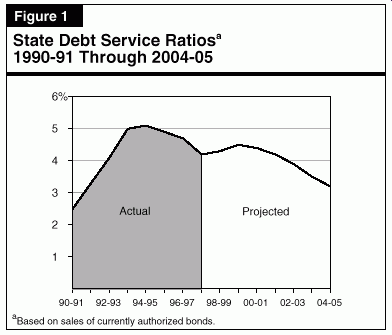
The level of debt payments expressed as a percentage of state General Fund
revenues is referred to as the state's "debt ratio." Figure 1
shows actual and projected debt ratios from 1990-91 through 2004-05. The figure
shows that as currently authorized bonds are sold, the state's debt ratio will
increase to 4.5 percent in 2000-01 and decline thereafter.
There is one general obligation bond measure on this ballot--$9.2 billion for the construction and renovation of public education facilities (kindergarten through twelfth grade and higher education).
If this bond measure is approved, we estimate that the state's bond debt payments would increase to $3.3 billion in 2003-04. At that time, the state's General Fund bond debt would total $28.3 billion (after accounting for the sale of some authorized bonds and the retirement of some debt). The debt ratio would increase to a projected peak of 4.7 percent in 2001-02 and decline thereafter. Voter approval of additional bonds at future elections or legislative authorization of additional lease-payment bonds would increase the state's debt.