Ballot Pages
Propositions on the November 3, 2026 Ballot
November 3, 2026 PDF Version
Proposition 1
Authorizes Bonds for Housing Affordability Programs. Legislative Statute.
Analysis of Measure
Background
Public Sector Funds Some Home Building. In most years, about 100,000 houses and apartments are built in California. Most of these housing units are built entirely with private dollars. Some, however, receive financial help from federal, state, or local governments. In the case of housing funded by the state, the state government generally provides local governments, nonprofit organizations, and private developers with grants or low-cost loans to fund a portion of the housing units’ construction costs. Typically, housing built with these funds must be sold or rented to Californians with low incomes.
Bonds Are a Common Way for the State to Fund Home Building and Homeownership Programs. Over the past few decades, the state has used general obligation bonds to fund various housing programs. Bonds are a way the state borrows money to cover the up-front costs of a development and then repays the money plus interest over time. The last statewide general obligation bond for affordable housing was approved by voters in 2024, providing $2 billion to provide housing for veterans and other people with mental health or substance use challenges who are facing homelessness.
Home Loan Program for Veterans. The state’s veterans home loan program provides home loans to eligible veterans, including veterans who may not otherwise qualify for a home loan. Under the program, the state sells general obligation bonds to investors and uses the funds to provide loans to veterans to purchase homes. Participating veterans repay the cost of the bonds through their payments on their home loan. The last statewide general obligation bond for veterans home loans was approved by voters in 2018, which provided $1 billion for the program.
Proposal
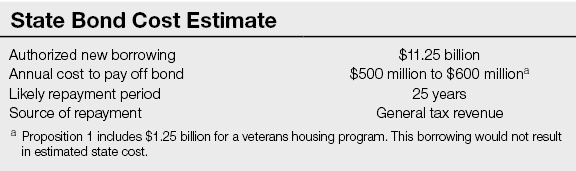
New General Obligation Bond for Housing. Proposition 1 allows the state to sell $11.25 billion in general obligation bonds for housing purposes. This amount consists of (1) a $10 billion bond for a variety of state housing programs that would be repaid by the General Fund and (2) a $1.25 billion bond that would be repaid by veterans’ payments on their home loans. (The General Fund is the account the state uses to pay for most public services, including education, health care, and prisons. For more information on the state’s General Fund-supported bonds, please see “Overview of State Bond Debt” later in this guide.)
State Housing Programs. Proposition 1 provides bond funding for various types of housing programs, which are summarized in Figure 1. The funds would be allocated over a number of years. The major categories of housing programs supported by the bond are:
- Affordable Multifamily Housing Programs. Proposition 1 provides $7.2 billion to acquire, build, or renovate rental housing, such as apartment buildings. These programs generally provide local governments and private developers with low-interest loans to fund part of the project cost. In exchange, projects generally must reserve units for low-income households for a period of 55 years. Some of this funding would be used for supportive housing, which provides on-site services (such as mental health and substance use counseling) to certain residents.
- Homeownership Programs. Proposition 1 provides $1.1 billion to support homeownership for low- and moderate-income households. Some of the funds would be used to provide homebuying assistance for first-time homebuyers through loans that generally do not have to be paid back until the home is sold or paid off. Other funds would be provided to nonprofit organizations and other entities for activities such as acquiring land to build homes for eligible low-income homebuyers and repairing existing homes owned by low-income households.
- Infrastructure Programs. Proposition 1 provides $500 million for a variety of infrastructure projects to support affordable housing developments, such as water, sewage, parks, and transportation improvements.
- Farmworker Housing Program. Proposition 1 provides $450 million in loans and grants to build or renovate housing for farmworkers. Program funds could be used for both rental and owner-occupied housing.
- Higher Education Student Housing Programs. Proposition 1 provides $350 million, split evenly between the University of California and California State University, for affordable student housing.
- Tribal Housing Program. Proposition 1 provides $200 million in grants to tribes. Funds could be used for various housing-related purposes, including construction and repair of rental and owner-occupied housing.
- Local Pilot Programs. Proposition 1 provides $200 million that would be available to cities, counties, and certain other entities for pilot projects aimed at developing housing at reduced costs.
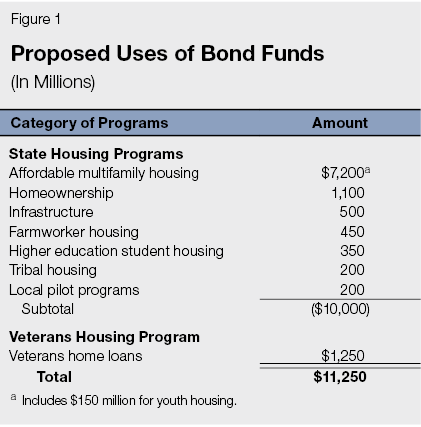
Veterans Housing Program. Proposition 1 also provides $1.25 billion for home loan assistance to veterans. Veterans generally use these loans to purchase single-family residences, condominiums, farms, and mobile homes.
Fiscal Effects
Increased State Cost to Repay the $10 Billion Bond for Housing Programs. The state General Fund cost to repay the bond would be $500 million to $600 million annually for about 25 years. The estimated annual cost would be about one-quarter of 1 percent (0.25 percent) of the state’s total General Fund budget. Since the state has to pay interest on the money it borrows, the total cost of the bond would be about 15 percent more (after adjusting for inflation) than if the state paid up front with money it already has.
No Direct State Cost for Veterans Housing Program. Veterans participating in the home loan program would make monthly payments to the state, allowing the state to repay the bonds. These payments have always covered the amount owed on the bonds, meaning the program has always operated at no direct cost to the state.
Administrative Costs. A number of state entities would experience increased costs to administer the various housing programs. A portion of the bond funds would cover these costs.
Impact of Funds. Much of the funding from Proposition 1 would be used together with other government monies to provide housing assistance. The bond funds would provide subsidies for up to 40,000 multifamily rental units, as well as about 2,500 units for farmworkers and about 1,200 beds for university students. The funds also would help up to 40,000 households, including about 2,100 veterans, with homeownership by providing homebuyer assistance and supporting the production and repair of homes.
Yes/No Statement
A YES vote on this measure means: The state could borrow $11.25 billion to support veterans and affordable housing.
A NO vote on this measure means: The state could not borrow $11.25 billion to support veterans and affordable housing.
Summary of Legislative Analyst’s Estimate of Net State and Local Government Fiscal Impact
- Increased state cost of $500 million to $600 million annually for about 25 years to repay the housing bond.
Ballot Label
Fiscal Impact: Increased state cost of $500 million to $600 million annually for about 25 years to repay the housing bond.