Ballot Pages
Propositions on the November 3, 2026 Ballot
November 3, 2026 PDF Version
Proposition 3
Provides Permanent Funding for Schools and Health Care by Extending Existing Tax on High Incomes. Initiative Constitutional Amendment.
Analysis of Measure
Background
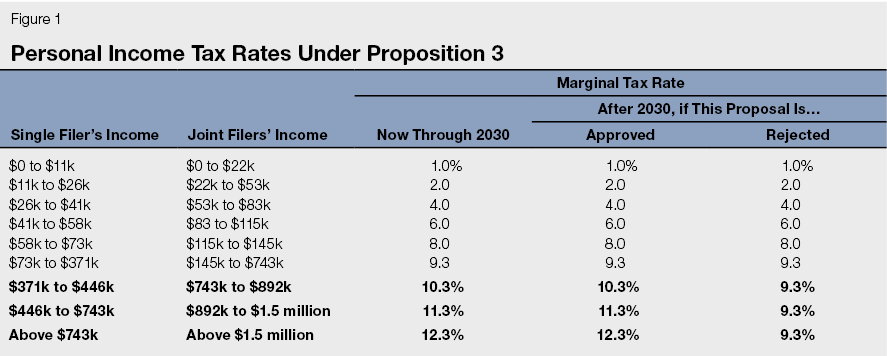
Most State Money Comes From the Income Tax. The income tax is the state’s largest tax. It pays for most spending from the state’s main operating account, the General Fund. The General Fund is the account the state uses to pay for most public services, including education, health care, and prisons. The tax applies to most types of income, such as salaries, wages, interest, and profits from the sale of stocks, property, and other investments. The income tax rate starts out low and gradually goes up for taxpayers with higher incomes. For example, a married couple pays a 1 percent tax on the first $21,000 of income, a 2 percent tax on income between $21,000 and $50,000, and a 4 percent tax on income between $50,000 and $80,000.
Prior Voter-Approved Tax Increases. Voters approved Proposition 30 in 2012 to temporarily increase income tax rates on high-income taxpayers. In 2016, voters approved Proposition 55 to extend these higher rates until 2030. The top 2 percent of California taxpayers pay these higher rates. These taxpayers pay about half of all state income taxes.
How Does the State Spend Its Money? This year, the state plans to spend about $250 billion from the General Fund to pay for services to the public. About half of this spending is for schools, community colleges, and the state’s public universities. (The State Constitution sets a minimum spending level for schools and community colleges.) About another one-third of state spending is for health and human services programs, mainly for the state’s low-income health insurance program, Medi-Cal. The rest goes mostly to prisons, courts, and other state services.
Proposal
Proposition 3 makes the higher income tax rates established by Proposition 30 permanent instead of letting them expire in 2031. Figure 1 shows what income tax rates would be if this measure passes and what they would be if it is rejected.
Fiscal Effects
Proposition 3 Would Bring in Between $5 Billion and $15 Billion Each Year. The amount of money brought in by Proposition 3 will go up and down a lot from year to year. This is because much of the revenue comes from taxing income that is closely tied to the stock market, which is always changing. In a weak year, the proposition might bring in around $5 billion in revenue to the state. In a strong year, the proposition might bring in $15 billion in revenue to the state. In most years, revenue would be in between these amounts.
Funding for Education and Other Programs. Proposition 3 results in funding for education and other programs. Roughly 40 percent of the funding would go to schools and community colleges. The rest would go to other state programs. Part of this amount would be set aside in budget reserves the state could use to fund these programs when revenues decline.
Yes/No Statement
A YES vote on this measure means: An income tax increase on high-income earners in place since 2012 would become permanent instead of expiring in 2031.
A NO vote on this measure means: An income tax increase on high-income earners in place since 2012 would expire in 2031.
Summary of Legislative Analyst’s Estimate of Net State and Local Government Fiscal Impact
- Maintains $5 billion to $15 billion of annual state income tax revenue by making a temporary tax increase on high-income earners permanent instead of letting it expire in 2031.
Ballot Label
Fiscal Impact: Maintains $5 billion to $15 billion of annual state income tax revenue by making a temporary tax increase on high-income earners permanent instead of letting it expire in 2031.