Ballot Pages
Propositions on the November 3, 2026 Ballot
November 3, 2026 PDF Version
Proposition 38
Authorizes Bonds for Immunology Medical Research. Initiative Statute.
Analysis of Measure
Background
Medical Research and Development (R&D) Is a Multi-Stage Process. The first stage of this process is basic research, which focuses on discovering new knowledge about how the human body works. The next stage is applied and clinical research, which aims to develop and test treatments for specific diseases. Universities do most of the basic research, while companies do most of the applied and clinical research. The third R&D stage is to have regulators review new treatments to make sure they are safe and effective. If a new treatment is approved, then it may be used on patients. Most R&D projects do not make it through all of these stages.
Medical R&D Is Funded in Various Ways. Funding for medical R&D in the United States totaled about $300 billion in 2023. Companies and government agencies (such as the National Institutes of Health) are the major funding sources for R&D nationally and in California. Beyond these funding sources, California voters have approved two ballot measures—Proposition 71 (2004) and Proposition 14 (2020)—giving the state authority to issue general obligation bonds to fund specified medical research. Combined, the two measures allowed the state to issue $8.5 billion in bonds for stem cell research. Bonds are a way for the state to borrow money, then repay it with interest over time. A general obligation bond is typically repaid from the state General Fund. (The General Fund is the account the state uses to pay for most public services, including education, health care, and prisons.) For more information about bonds, see “Overview of State Bond Debt” later in this guide.
Proposal
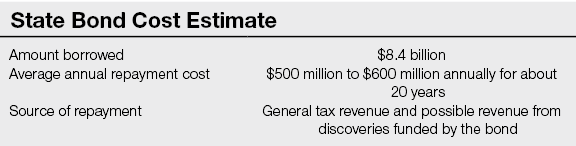
New Bond for Specified Medical Research. Proposition 38 allows the state to issue an $8.4 billion general obligation bond for research in immunology and immunotherapy. Immunology is the study of the body’s immune system and how it protects the body from abnormal cells and other causes of disease. Immunotherapy develops treatments that help the immune system fight diseases more effectively. The measure requires that at least $4.2 billion of the bond funds be used for immunology research on cancer, heart disease, and Alzheimer’s disease. No more than 2 percent of total bond funds may be used for state administrative costs. Payments on the bond would come from the state General Fund.
Supports a Research Institute. About half of the bond funds would go to a research institute specializing in immunology and immunotherapy. The California Department of Public Health (CDPH) would select the institute. The selected institute must meet several criteria, including criteria related to its size, funding, and collaboration with a University of California (UC) campus. The institute would use the bond funds for research. Each year, the institute must issue a public report on its activities and have an independent financial audit.
Supports Research Grants. A council would give out the other half of bond funds as competitive research grants focused on immunology and immunotherapy. The council would consist of representatives from 7 UC campuses and 10 to 15 other universities and nonprofit research institutions in California. The council would set research priorities and select grant recipients from among its member organizations. Similar to the institute, the council would have public reporting and audit requirements.
Requires 10 Percent of Revenue From Discoveries First Be Used to Repay the State. Proposition 38 requires that the institute, in consultation with CDPH, try to generate the most revenue possible from the funded research. (Research, for example, could lead to the development of a new medical treatment.) Ten percent of any revenue generated must be given to the state. This revenue must first go into the state General Fund until it repays the cost of the research bond (the amount borrowed plus the interest). Any additional revenue would be used for future immunology and immunotherapy research.
Has Two Other Notable Provisions.
- Requires Purchases From California Suppliers. Grant recipients must buy at least half of their goods and services from California suppliers when reasonably possible.
- Requires California Patient Discount. Any treatment developed through funded research and sold in California must generally be offered at a 20 percent discount.
Fiscal Effects
Increased State Cost of $500 Million to $600 Million Annually for About 20 Years to Repay the Bond. The state General Fund cost to repay the bond would be $500 million to $600 million annually for about 20 years. The annual cost would be about one-quarter of 1 percent (0.25 percent) of the state’s total General Fund budget. Since the state has to pay interest on the money it borrows, the total cost of the bond would be about 10 percent more (after adjusting for inflation) than if the state paid up-front with money it already has.
Potential State Revenue From Research Discoveries. The state could receive revenue from research funded by Proposition 38. The amount of revenue is uncertain but could be significant. It would depend on how many research projects lead to marketable treatments and how much money any given treatment generates. The timing of these revenues and how long it would take to offset the state’s bond cost is also uncertain, but could take decades.
Potential Indirect Fiscal Effects. Proposition 38 likely would have some indirect fiscal effects, particularly on costs for state health programs (such as Medi-Cal, which pays for health care for low-income Californians). For example, if the funded research leads to new medical treatments, the average cost of patient care could either increase or decrease. As a result, the overall effect on program costs is uncertain.
Yes/No Statement
A YES vote on this measure means: The state could borrow $8.4 billion to support medical research in immunology and immunotherapy conducted by California research institutes and universities.
A NO vote on this measure means: The state could not borrow $8.4 billion to support medical research in immunology and immunotherapy conducted by California research institutes and universities.
Summary of Legislative Analyst’s Estimate of Net State and Local Government Fiscal Impact
- Increased state cost of $500 million to $600 million annually for about 20 years to repay the medical research bond. The state could recover part or all of this cost in subsequent decades if the funded research leads to discoveries that generate revenue.
Ballot Label
Fiscal Impact: Increased state cost of $500 million to $600 million annually for about 20 years to repay the research bond, with some or all of the cost offset if the funded research generates revenue.