Ballot Pages
Propositions on the November 3, 2026 Ballot
November 3, 2026 PDF Version
Proposition 45
Modifies Environmental Review for Certain Projects. Initiative Statute.
Analysis of Measure
Background
State Law Requires Government Agencies to Review the Environmental Impacts of Proposed Projects. State and local government agencies are responsible for reviewing and approving certain projects before they can be built. As part of this process, the California Environmental Quality Act (CEQA) requires an agency to consider how a project might negatively affect the environment before approving it. CEQA applies to many types of public and private projects, such as housing developments, school facilities, and highway expansions. Some exceptions apply. For example, state law exempts certain housing developments located near public transit from needing a CEQA review.
How the CEQA Process Works. The government agency first determines if CEQA applies to a project. If so, it then determines if the project could significantly affect the environment and if those impacts could be avoided or reduced with minor changes to the project. If making minor changes cannot avoid or reduce significant impacts, the agency must do a more detailed review called an environmental impact report (EIR). (The majority of projects do not require an EIR; however, EIRs are somewhat more common for large and complex projects.) The EIR analyzes possible environmental impacts the project could cause and considers alternatives that could reduce those impacts. After finishing the environmental review, the agency decides whether to approve the project. At certain times during this process, the government agency must seek and consider comments about the project’s environmental review from the public and other government agencies.
People Can Sue the Government Agency About Its CEQA Review. After a government agency has completed the CEQA review and decided whether to approve a project, people who think the agency did not follow the CEQA process correctly can sue the agency. For example, a project opponent might argue that the environmental analysis was inadequate. If the court finds that the agency did not follow CEQA correctly, it can stop the whole project and require the agency to fix the part of the process that was problematic.
Many Projects Also Need to Get Other Approvals. Besides CEQA review, many projects need approval or permits from other local and/or state government agencies before they can proceed. For example, a business that wants to build a health clinic might need the local government to change land use rules before it can proceed. It also may need state agencies to review and approve how the project might affect certain wildlife species and water quality.
Proposal
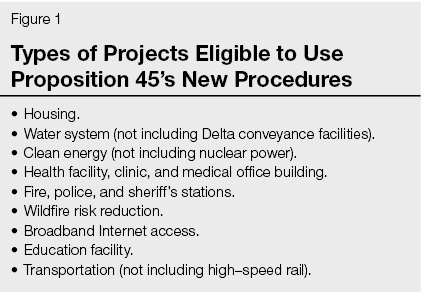
Proposition 45 creates new procedures for reviewing certain types of projects that it defines as “essential.” Figure 1 lists the types of projects eligible for the new procedures. The proposition (1) tightens time limits for CEQA review, permits, and court challenges; (2) changes parts of the CEQA review process; and (3) changes the court’s review process for CEQA lawsuits. The proposition gives eligible project applicants the option of using the new procedures or existing procedures.
Tightens Time Limits for Review and Court Challenges of Eligible Projects. Proposition 45 creates more binding time limits for state and local governments to do both CEQA and permitting reviews. This includes time limits for determining if a project application is complete, finishing the EIR, and granting other types of approvals and permits. For example, Proposition 45 allows an applicant to request an agency hearing—and potentially file a lawsuit with the courts—if an agency does not meet the 365-business-day time limit for finishing the EIR. The proposition also creates a time limit for courts to resolve legal challenges.
Changes CEQA Review for Eligible Projects. For eligible projects, Proposition 45 makes several changes to the CEQA review process, including:
- Application Process. Requires the government agency to specify all information that must be included in an application before it is submitted. (Current law allows agencies to repeatedly request additional information or project changes.)
- How Environmental Impacts Are Assessed. Requires the agency to assess potential environmental impacts based on the laws and standards in place at the time the project application is submitted. (Current law lets the agency consider new information and revise its review standards when doing the EIR.)
- Project Alternatives. Allows the applicant to develop only one project alternative for the agency to consider. (Current law requires the agency—not the applicant—to develop and consider multiple project alternatives that could reduce environmental impacts.)
- Consultation With Native Tribes. Requires the agency and applicant to consult about the project only with California native tribes that have been formally recognized by the federal government. (Current law requires consultation with a wider range of tribes.)
- Public Comment Periods. Limits how long the agency can accept comments from the public and other government agencies about the project. (Current law sets a minimum number of days—not a maximum—for public review.)
Changes How Courts Review Challenges to Eligible Projects. Proposition 45 makes several changes to the court’s review process when someone challenges a government agency’s approval of an eligible project. For example, it reduces the scope of what the court can consider in CEQA lawsuits. The proposition also prevents the court from stopping the whole project if it finds that the agency did not follow CEQA correctly. Instead, the court can only stop the part of the project where the environmental review did not comply with CEQA while the agency fixes the problem.
Fiscal Effects
Initial Costs for State and Local Governments. During the first several years, Proposition 45 likely would increase costs for the state and local governments, including state courts. These costs likely would be in the high tens of millions of dollars annually, potentially exceeding $100 million annually. For example, state and local governments would have costs to develop new guidelines and standards for reviewing eligible projects’ environmental impacts, meet tighter time limits, and address court challenges. Fees paid by project applicants and people filing lawsuits would cover some of these costs. After this initial period, while some costs could continue, others likely would decline over time. For example, the changes to how courts can review CEQA lawsuits could mean fewer people will sue in the future, which could reduce costs for agencies and state courts in the long term.
In the Longer Term, Uncertain but Potentially More Significant Fiscal Effects. Proposition 45’s changes to project review and court challenge procedures for eligible projects could have various fiscal effects for state and local governments. The overall fiscal effect of these changes—positive or negative—is uncertain but could be more substantial than the near-term effects. For example, two effects that could have significant but uncertain impacts are:
- More Projects and Faster Timing. To the degree that Proposition 45’s changes to project review and court challenge procedures lead to eligible public projects being constructed more quickly, state and local governments likely would have lower project costs. Additionally, if the proposition’s changes result in more projects being completed overall, it could lead to an increase in tax revenues, such as from property taxes.
- Negative Environmental Impacts. To the degree that Proposition 45’s changes to project review and court challenge procedures lead to approval of projects with negative environmental impacts that would not have otherwise occurred, government agencies could face higher costs to respond to those impacts.
Yes/No Statement
A YES vote on this measure means: Certain public and private projects would be eligible for new project review and court challenge procedures. For example, new procedures would tighten time limits for environmental review and reduce the scope of what courts can consider when reviewing legal challenges.
A NO vote on this measure means: Public and private projects would continue to use existing project review and court challenge procedures.
Summary of Legislative Analyst’s Estimate of Net State and Local Government Fiscal Impact
- Initial costs for state and local governments, likely in the high tens of millions of dollars annually—potentially exceeding $100 million annually—to implement new project review and court challenge procedures for eligible projects. Fees paid by project applicants and people filing lawsuits would partly cover these costs.
- In the longer term, uncertain, but potentially more significant positive or negative fiscal effects for state and local governments. The overall effect depends, in part, on how the new procedures change the number of eligible projects that get built and whether those projects have different environmental impacts.
Ballot Label
Fiscal Impact: Initial costs for state and local governments, likely in the high tens of millions of dollars—potentially exceeding $100 million—annually, partly covered by fees. Uncertain, potentially more significant positive or negative longer-term fiscal effects.