Anita Lee

February 11, 2026
The 2026‑27 Budget
Department of Justice
Overview
Roles and Responsibilities. Under the direction of the Attorney General, the Department of Justice (DOJ) provides legal services to state and local entities; brings lawsuits to enforce public rights; and carries out various law enforcement activities, such as ensuring lawful ownership or possession of firearms and ammunition. DOJ also provides various services to local law enforcement agencies, including providing forensic services. Finally, DOJ manages various databases, including the statewide criminal history database.
Spending Proposed for 2026-27. As shown in Figure 1, the Governor’s budget proposes $1.3 billion to support DOJ operations in 2026-27—a decrease of $13 million (or 1 percent) from the revised amount for 2025-26. A little more than half of the proposed funding supports DOJ’s Division of Legal Services, while the remainder supports the Division of Law Enforcement and the California Justice Information Services Division (CJIS). Of the total amount proposed for DOJ operations in 2026-27, $508 million (or 39 percent) is from the General Fund. This is a decrease of $19 million (or 3.6 percent) from the revised 2025-26 General Fund amount—reflecting the net effect of a variety of technical and workload budget adjustments. The remaining support for DOJ operations comes from a number of special funds and reimbursements, including from other state departments for the provision of legal services. The proposed budget would provide DOJ with a total of 6,093 positions in 2026-27, a decrease of 11 positions (or less than 1 percent) from the revised 2025-26 level.
Figure 1
Department of Justice Budget Summary
(Dollars in Millions)
|
2024‑25 |
2025‑26 |
2026‑27 |
Change From 2025‑26 |
||
|
Amount |
Percent |
||||
|
Legal Services |
$636 |
$671 |
$691 |
$21.0 |
3.1% |
|
Law Enforcement |
297 |
362 |
343 |
‑19.0 |
‑5.3 |
|
California Justice Information Services |
265 |
289 |
275 |
‑15.0 |
‑5.1 |
|
Totals |
$1,198 |
$1,322 |
$1,309 |
‑$13.4 |
‑1.0% |
Funding for Firearm-Related Workload
Background
Bureau of Firearms (BOF) Primarily Responsible for Regulating and Enforcing State’s Firearm and Ammunition Laws. DOJ’s BOF is primarily responsible for the regulation and enforcement of the state’s firearm and ammunition laws. This includes conducting background checks for people seeking to purchase firearms and ammunition, licensing firearm and ammunition vendors, and administering various other firearm and ammunition programs. BOF engages in various activities related to these responsibilities. For example, BOF has enforcement teams who are primarily responsible for investigating the illegal purchase or possession of firearms and ammunition, as well as seizing them from people who are prohibited from owning or possessing them.
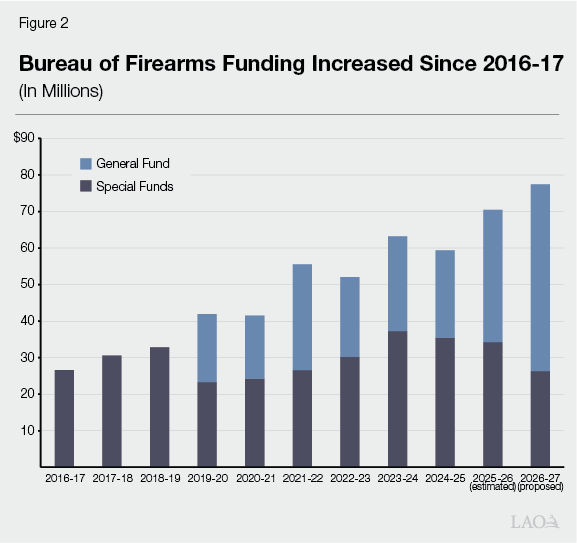
Overall BOF Funding and General Fund Support Increased Over Past Decade. As shown in Figure 2, support for BOF has increased over the past decade from $26.6 million in 2016-17 to $70.4 million in 2025-26—an increase of $43.8 million (or 165 percent). During this period, BOF also shifted from being fully supported by various special funds and began receiving General Fund support in 2019-20. Of the total $70.4 million provided to BOF in 2025-26, $36.2 million (or 51 percent) was from the General Fund and $34.2 million (or 49 percent) was from various special funds. A large portion of the General Fund support is used to support the Armed and Prohibited Persons System (APPS) enforcement teams, which seize firearms from people prohibited from owning or possessing them. Support for these teams was fully shifted over to the General Fund as part of the 2019-20 budget package. In the past couple of years, the General Fund—rather than special funds—have been used to support the costs of implementing some new firearm-related legislation and workload. (CJIS separately receives millions of dollars annually from several fund sources to maintain and update various databases needed to support BOF’s activities.)
Five Firearm or Ammunition-Related Special Funds Support BOF Workload. Separate from the General Fund, five firearm and ammunition-related special funds support BOF workload. These five funds include: (1) Dealers’ Record of Sale (DROS) Special Account, (2) Firearms Safety and Enforcement Special Fund, (3) Firearm Safety Account, (4) Ammunition Safety and Enforcement Special Fund, and (5) Ammunition Vendors Special Account. State law authorizes DOJ to charge various fees related to firearms and ammunition that are deposited into these funds to support BOF programs and activities. For example, a person purchasing a firearm currently pays fees totaling $37.19—a $31.19 fee deposited into the DROS Special Account (the “DROS fee”), a $5 fee into the Firearm Safety and Enforcement Special Fund, and a $1 fee into the Firearm Safety Account. State law also authorizes DOJ to administratively increase some of these fees to account for inflation as long as the fee does not exceed DOJ’s regulatory and enforcement costs. State law authorizes revenues deposited into each of these special funds to be used for various purposes.
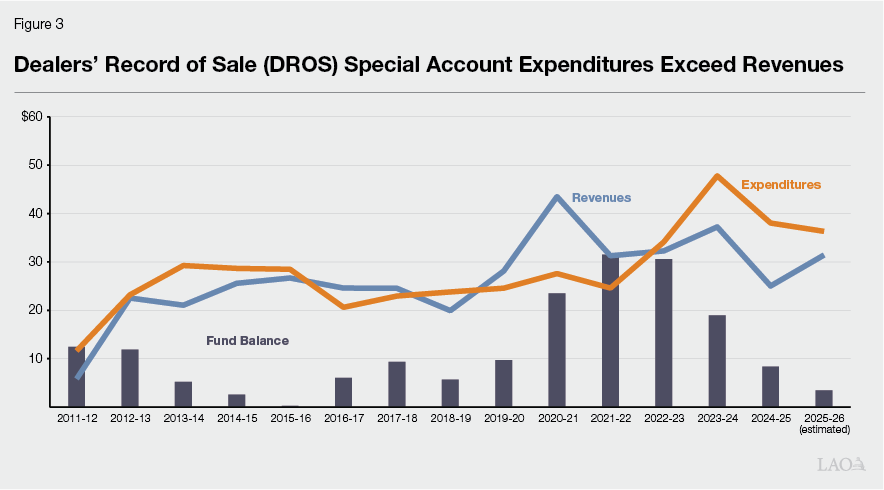
DROS Special Account Is the Primary Special Fund Supporting BOF. The DROS Special Account is the primary special fund supporting BOF activities. This is because it receives the most fee revenue. Additionally, the statutorily permissible uses of the fund are quite broad. Specifically, the DROS Special Account may generally be used to offset DOJ’s reasonable costs of firearm-related regulatory and enforcement activities pertaining to the sale, purchase, manufacturing, lawful or unlawful possession, loan, or transfer of firearms. As shown in Figure 3, DROS Special Account revenues often fluctuate from year to year, generally reflecting changes in fee levels and the number of firearms sold. DROS Special Account expenditures routinely exceeded revenues prior to 2019-20—resulting in the decline of the fund balance. To help ensure sufficient revenues would be available to support BOF workload, Chapter 736 of 2019 (AB 1669, Bonta) enabled DOJ to increase the DROS fee charged from $19 to $31.19. For a couple years after this fee increase, revenues generally exceeded expenditures—thereby allowing the fund balance to steadily grow. However, beginning in 2022-23, expenditures began outpacing revenues, shrinking the fund balance. The Governor’s budget estimates that the DROS Special Account will be insolvent in 2026-27 if no action is taken.
Governor’s Proposal
The Governor’s budget proposes $20.4 million General Fund in 2026-27 (decreasing to $259,000 ongoing beginning in 2029-30) to support DOJ firearm workload. This includes the three proposals described below.
Continuation of the Firearms Information Technology Systems Modernization (FITSM) Project. The budget includes $11.2 million one-time General Fund in 2026-27 to continue the FITSM project. This project would replace 17 existing firearm and ammunition databases and systems.
Shift in BOF Costs to General Fund. To address an anticipated insolvency in the DROS Special Account, the budget proposes to shift $8 million annually through 2028-29 in BOF costs from the DROS Special Account to the General Fund. This amount includes support for five units within BOF.
Chapter 591 of 2025 (SB 704, Arreguín). The budget proposes $1.2 million General Fund in 2026-27 (decreasing to $259,000 annually beginning in 2027-28) for the implementation of Chapter 591. Chapter 591 requires the sale or transfer of firearm barrels be completed in person by a licensed firearms dealer. As of July 2027, it also requires the licensed firearms dealer check that a purchaser is allowed to possess firearms and record certain information, such as the date of the purchase. It also directs DOJ require licensed firearms dealers charge a fee of up to $5 per check (not to exceed actual processing costs). This fee may be increased annually by up to $1, but may not exceed actual costs.
Assessment
Chapter 591 Envisioned Fee Revenue, Not General Fund, Support. As noted above, Chapter 591 included specific language requiring DOJ to direct firearm dealers to charge a fee with the goal of covering DOJ’s costs to check that purchasers are permitted to possess firearms. As such, General Fund should not be provided to support this workload. Because these checks will not begin until July 2027, DOJ will have costs to implement Chapter 591—including updating its systems—prior to revenue being collected. It would be reasonable to provide a loan, such as from another firearm special fund with sufficient resources, to support this workload in the immediate term. This loan would then be repaid with collected fee revenue.
Special Funds Unable to Support BOF Costs… As noted above, the DROS Special Account is estimated to be insolvent in 2026-27 absent any action. The condition of the DROS Special Account would be even worse if it also supported all firearm-workload it could statutorily support that is currently supported by the General Fund. The four other special funds similarly would be unable to absorb BOF workload costs that are currently supported by the General Fund. This is because they face structural shortfalls in which expenditures exceed revenues, generally receive less revenue, or can only be used for a relatively narrow number of activities.
…Which Will Then Require General Fund Support in the Near Term… The constraints on the firearm special funds means that General Fund support will be needed, at least in the short run, to maintain DOJ firearm operations. Accordingly, the Governor’s proposal to support FITSM costs from the General Fund is reasonable as the requested amount is only for 2026-27 and ensures that this necessary project continues uninterrupted. Similarly, the proposal to temporarily shift $8 million in BOF costs from the DROS Special Account to the General Fund ensures that BOF operations will be maintained at current levels.
…Until the Insolvency of the DROS Special Account Is Permanently Addressed. The proposal to temporarily shift $8 million in BOF support to the General Fund will not permanently address the underlying insolvency of the DROS Special Account. While shifting costs permanently to the General Fund could arguably address the issue, we note that more support could be needed as additional firearm-related legislation is enacted. Additionally, providing General Fund to support firearm-related workload will come at the expense of other General Fund priorities given the multiyear deficits facing the state.
State Typically Sets Fees to Support Regulatory or Enforcement Activities… The state typically establishes fees to fully support state entities’ costs to license, regulate, and enforce laws within a particular industry. A key example is the state’s licensing and regulatory activities for various professions—such as doctors, and accountants—overseen by the Department of Consumer Affairs (DCA). The entire $757 million 2026-27 budget for DCA is proposed to be supported by fees charged to each profession. Such fees are regularly adjusted or approved by the Legislature as needed to cover increased workload and costs.
…But Recent U.S. Supreme Court Comment on Firearm Regulatory Fees Raises Questions About This Approach for Firearms and Ammunition. In June 2022, the U.S. Supreme Court issued a decision in the New York State Rifle & Pistol Association v. Bruen case that found laws requiring people provide “good cause” to carry a concealed weapon to be unconstitutional. As a result, states that want to regulate a person’s ability to carry concealed weapons (including California) must have “shall-issue” regulatory regimes, meaning such states are required to issue carry concealed permits to people seeking them if they meet nondiscretionary criteria. The decision included the following footnote: “Because any permitting scheme can be put towards abusive ends, we do not rule out constitutional challenges to shall-issue regimes where, for example, lengthy wait times in processing license applications or exorbitant fees deny ordinary citizens their right to public carry.” This footnote suggests that there may be a point where firearm regulatory fees become unconstitutionally high.
Concerns With DROS Special Account Insolvency Led to Greater Use of General Fund… As shown in Figure 2, support for BOF followed a fee-based funding structure through 2018-19, with all BOF costs supported by special funds. This changed in 2019-20 when the state decided to shift full support for the APPS Program from the special funds to the General Fund, in part to address the solvency of the firearm special funds. With the passage of Chapter 736 to increase the fee deposited into the DROS Special Account, the Legislature took steps to shift more of the cost of BOF back onto special funds. Despite that action, DOJ firearm-related costs stemming from increased workload, newly enacted legislation, and the FITSM project continued to push the fund toward insolvency. This looming insolvency of the DROS Special Account has led to DOJ increasingly requesting General Fund resources to support firearm-related workload that can statutorily be supported by the special funds. In 2026-27, the Governor’s budget projects that two-thirds of support for BOF will come from the General Fund.
…Leading to Inconsistencies in How Workload Is Funded… The increasing provision of General Fund has led to some inconsistency in what is funded by the General Fund versus the firearm special funds. For example, the 2023-24 budget package included $19.3 million in 2023-24 (decreasing to $6 million annually beginning in 2026-27)—mostly from the DROS Special Account—for the implementation of five pieces of enacted legislation, increased or new baseline workload, and the continuation of FITSM. In contrast, the 2024-25 budget package included $16.2 million in 2024-25 (decreasing to $11.9 million annually in 2028-29)—mostly from the General Fund—for the implementation of five pieces of enacted legislation and the continuation of FITSM. Both budget packages included some budget requests to fund similar types of workload but this workload was supported with different fund sources in each budget act. For example, FITSM was funded by the DROS Special Account in 2023-24 and the General Fund in 2024-25. The Governor’s budget again proposes General Fund support for FITSM in 2026-27.
…Suggesting State May Want to Examine Its Regulatory Fee Structure, Particularly Given Limited General Fund Capacity for Ongoing Commitments. The inconsistencies in how the state supports current firearm workload and the changing legal landscape suggests the state may want to examine its regulatory fee structure to more consistently determine what regulatory and enforcement activities should be supported by regulatory fees versus the General Fund. This would then help the Legislature determine the appropriate fee levels for existing and future costs. This is especially critical given the multiyear deficits facing the state that leave no capacity for new ongoing commitments, meaning any additional General Fund provided for firearms regulation would likely require reduced spending for other existing state programs. For example, FITSM will require significant resources—potentially in the hundreds of millions of dollars—in the coming years to be completed. To the extent that fees are available to support BOF activities, it would minimize the need for General Fund resources. To the extent fee revenues are not available to support DOJ’s firearm-related workload, General Fund could be necessary—but would come at the cost of other budget priorities.
Recommendations
Modify Chapter 591 Proposal to Support It With a Loan and Fee Revenue. We have no concerns about the amount requested by DOJ to implement Chapter 591. However, rather than providing General Fund to support its costs, we recommend the Legislature modify the proposal to support it from the DROS Special Account. Eventually, revenue from the $5 fee created by Chapter 591 should be sufficient to allow the DROS Special Account to support these costs. In the near term, however, we recommend that the Legislature also modify the proposal to support the initial costs of Chapter 591 with a loan from the Firearms Safety and Enforcement Special Fund. This special fund has a sufficient fund balance to support such costs in the coming year and can await repayment from the DROS Special Account until sufficient fee revenues are collected.
Approve FITSM Request. We recommend the Legislature approve the Governor’s proposal for $11.2 million in one-time General Fund support to continue the FITSM project. This will ensure that this necessary project remains uninterrupted.
Modify Proposal to Shift BOF Support to General Fund. We recommend the Legislature modify the Governor’s proposal to shift $8 million in BOF costs from the DROS Special Account to the General Fund annually through 2028-29. Specifically, we recommend approving this shift for only one year. Additionally, given the fiscal difficulties facing the state, the Legislature could consider providing the General Fund as a loan. When and how this loan would be repaid could be considered as part of the Legislature’s deliberations on how to support firearm-related workload on an ongoing basis. Such an action would ensure that existing BOF operations are maintained while the Legislature weighs its options for how to support firearm-related workload moving forward. These options would be informed by the recommended framework we discuss in more detail in the following section. These options would also address the long-term solvency of the DROS Special Account and other firearm and ammunition-related special funds.
Direct DOJ Provide a Framework for Determining What Workload Should Be Funded by Fee Revenues. We recommend the Legislature direct DOJ to provide a potential framework by January 10, 2027 for determining what firearm and ammunition workload should be funded by special fund fee revenues. In developing this framework, DOJ can evaluate its entire workload, the potential impact of FITSM and other actions that can help improve efficiency, and existing federal and state statute and case law. The framework should provide clear explanations for how the identified workload should be funded, the calculation of appropriate fee levels and how such calculations were reached, recommendations for how frequently the fees should be adjusted and the process by which they should be adjusted, and any recommendations for statutory changes specifying the allowable uses for the special fund revenues. Such a report could help inform legislative decision-making on how such workload could be supported in the future.
Use Framework to Inform Future Actions. The Legislature could use the DOJ framework to inform its future actions. This could include aligning firearm and ammunition-related workload with the appropriate fund source. This would then allow the Legislature to determine what fee levels it is comfortable with—which could be higher or lower than those recommended by DOJ. If the fee levels are lower than current or projected costs, the Legislature would be better equipped to assess (1) how much of this workload needs to be supported from the General Fund at the cost of other budget priorities or (2) whether the cost of the workload needs to be reduced—such as through statutory or other changes—to avoid such budgetary trade-offs.