Natalie Gonzalez

February 24, 2026
The 2026-27 Budget
California State University
Summary
Brief Covers the California State University (CSU). This brief reviews key funding and spending trends at CSU, then analyzes the Governor’s budget proposals relating to CSU’s core operations and enrollment.
CSU’s Spending Has Not Outpaced Inflation. CSU’s two main sources of core funding are state General Fund and student tuition revenue. General Fund has been growing as a share of CSU’s total core funding while the tuition share has fallen. CSU uses core funding for its core operations. From 2019‑20 through 2024‑25, core spending at CSU increased at an annual average rate of 3.6 percent, slightly lower than the rate of inflation. Over this period, CSU’s largest expense remained employee compensation (comprising 75 percent of core operating expenditures).
Recommend Reducing or Eliminating Base Increases. The Governor proposes to increase ongoing base General Fund support for CSU by $366 million (7 percent) in 2026‑27 and assumes CSU will collect an additional $201 million in student tuition revenue. Given the state is facing multiyear deficits, the Legislature could consider providing CSU with a smaller base increase that is more closely aligned with inflation or eliminating the base increase altogether. These options make the state’s structural deficit more manageable while helping sustain core programs moving forward and reducing pressure for future reductions. Absent the 7 percent base increase, CSU’s core funding would still increase by 4.2 percent.
Recommend Removing Out‑Year Funding Commitments. Under the Governor’s budget, the state would make two additional out‑year funding commitments to CSU—a one‑time back payment of $252 million in 2027‑28 and a 3 percent ongoing base increase of $151 million in 2028‑29. We recommend removing these out‑year funding commitments. Rather than making commitments in advance, the Legislature could determine each year how much support it can afford to provide CSU in light of overall fiscal conditions and competing budget priorities.
Recommend Using Available One‑Time Funding to Retire Payment Deferral. The 2025‑26 Budget began deferring a $144 million General Fund payment to CSU from one fiscal year to the next. When one‑time funding becomes available, we recommend the Legislature make retiring this payment deferral a high priority. Retiring the payment deferral would return CSU’s state payments to their regular schedule, eliminate the associated debt obligation, and reduce state budgetary pressures in the out‑years.
Recommend Funding Lower Level of Enrollment Growth, Separately From Base Increase. The Governor’s budget maintains the enrollment expectation set forth in the 2025‑26 Budget Act. CSU projects it will increase enrollment in 2026‑27 but fall short of the state’s target. Thus, we recommend the Legislature set a lower target. We also recommend funding enrollment growth apart from and on top of any base increase to provide greater transparency and accountability. Though the Legislature may face difficult choices regarding what ongoing spending to prioritize in 2026‑27, we think there is a rationale to prioritize funding for enrollment growth given CSU is already making some admissions decisions.
Recommend Holding Enrollment Flat in 2027‑28. In a departure from recent practice, the Governor does not propose an enrollment growth target for 2027‑28. Given the sizeable projected deficit in 2027‑28, we recommend holding enrollment expectations flat for CSU that year. This prevents CSU from being directed to enroll more students in the potential absence of associated funding, which could negatively impact students through larger class sizes, fewer course offerings, and less academic support.
Introduction
Brief Focuses on CSU. CSU is one of California’s three public higher education segments. Its 23 campuses provide undergraduate and graduate education. CSU focuses on academic degrees through the master’s level, but it also provides doctoral degrees in certain, primarily applied, fields. This brief is organized around the Governor’s 2026‑27 budget proposals for CSU. The first section provides an overview of CSU’s budget and the planned changes for 2026‑27. The following two sections focus on core operations and enrollment, respectively.
Overview
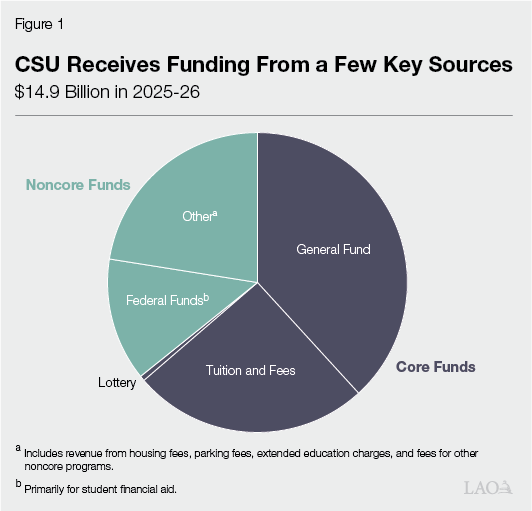
CSU’s Budget Is $14.9 Billion in 2025‑26. As Figure 1 shows, CSU receives funding from various sources. The state generally focuses its budget decisions around CSU’s “core funds,” or the portion of its budget supporting its academic mission. Core funds at CSU primarily consist of state General Fund and student tuition revenue, with a very small share coming from state lottery revenue. In 2025‑26, core funds comprise approximately 65 percent of CSU’s budget. Between 2024‑25 and 2025‑26, ongoing core funds per student increased 2 percent. The average annual growth rate of ongoing core funds per student has been approximately 3.8 percent over the past ten years. The remainder of CSU’s revenue comes from various noncore sources including housing fees, parking fees, and extended education charges.
Ongoing Core Funding Increases by $765 Million Under Governor’s Budget. As Figure 2 shows, ongoing core funding increases by 8.1 percent in 2026‑27. All core fund sources increase. Notably, General Fund support increases by $553 million (9.8 percent), and tuition and fee revenue is estimated to increase by $201 million (5.3 percent). The increase in tuition and fee revenue is due to both higher tuition charges and enrollment growth.
Figure 2
CSU’s 2026‑27 Ongoing Core Funding Increases by 8.1 Percent
(Dollars in Millions, Except Funding Per Student)
|
2024‑25 |
2025‑26 |
2026‑27 |
Change From 2025‑26 |
||
|
Amount |
Percent |
||||
|
Ongoing Core Funds |
|||||
|
General Funda |
$5,479 |
$5,622 |
$6,175 |
$553 |
9.8% |
|
Tuition and feesb |
3,527 |
3,790 |
3,991 |
201 |
5.3 |
|
Lottery |
69 |
82 |
93 |
11 |
13.4 |
|
Totals |
$9,075 |
$9,494 |
$10,259 |
$765 |
8.1% |
|
FTE studentsc |
402,506 |
412,940 |
419,950 |
7,010 |
1.7% |
|
Funding per student |
$22,545 |
$22,991 |
$24,429 |
$1,438 |
6.3 |
|
aIncludes funding for pensions and retiree health benefits. bIncludes funds used for student financial aid. cReflects total combined resident and nonresident enrollment. The 2025‑26 number incorporates CSU’s planned resident enrollment growth. |
|||||
|
FTE = full‑time equivalent. |
|||||
Governor Proposes Unrestricted Base Increases for CSU. As Figure 3 shows, the Governor’s budget includes three components relating to CSU’s base General Fund support. Most notably, the budget provides two unrestricted ongoing base increases totaling 7 percent. It also restores CSU’s base support for the one‑time removal of $144 million for the payment deferral initiated last year. Beyond these proposals, the Governor’s budget includes adjustments to retiree health benefits costs and certain pension costs. Additionally, the Governor maintains the enrollment expectations set forth in the 2025‑26 Budget Act, which specify that CSU is to grow resident undergraduate enrollment by 10,161 full‑time equivalent (FTE) students (2.9 percent) in 2026‑27. The Governor expects CSU to cover the cost of this enrollment growth from within the proposed base increases.
Figure 3
Higher CSU Spending Is Primarily
Due to Base Increases
Ongoing General Funding Changes, 2026‑27 (In Millions)
|
Ongoing Spending |
|
|
Base increase (5 percent) |
$265 |
|
Base restorationa |
144 |
|
Base increase (2 percent delayed from 2025‑26) |
101 |
|
Retiree health benefits cost increase |
60 |
|
Pension cost adjustmentb |
‑17 |
|
Total |
$553 |
|
aThe 2025‑26 Budget Act included a payment deferral from 2025‑26 to 2026‑27. The Governor’s budget backfills for the one‑time reduction related to that payment deferral. bLAO estimate based upon CalPERS published rates. The administration intends to update its rates in the May Revision. |
|
Core Operations
In this section, we first discuss CSU’s sources of core funding and track how funding has changed over time. We then discuss CSU’s cost pressures and track how they have changed over time. Next, we describe the Governor’s proposals relating to CSU’s base budget, assess those proposals, and make associated recommendations.
Funding Trends
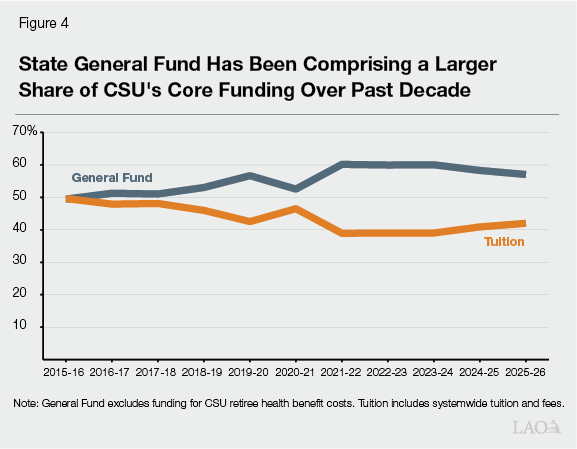
CSU’s Reliance on State Support Has Changed Over Time. State General Fund support for CSU has fluctuated over time, tending to increase during economic expansions and retract during recessions. As Figure 4 shows, since 2015‑16, state General Fund as a share of CSU’s total core funding has been increasing—rising from 49 percent in 2015‑16 to 57 percent in 2025‑26. At the same time, revenue from tuition and fees has been declining as a share of CSU’s total core funding—falling from 50 percent in 2015‑16 to 42 percent in 2025‑26. These trends are largely due to the state providing CSU with General Fund base increases in most years over that period while CSU increased tuition only three times (in 2017‑18, 2024‑25, and 2025‑26).
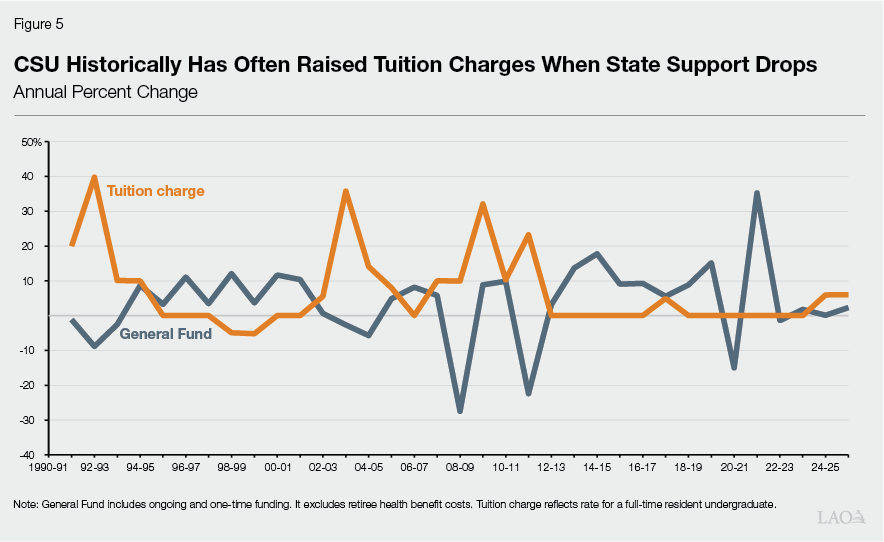
CSU Tuition Charges and State Support Historically Move in Opposite Directions. For most of the past 30 years, neither the state nor CSU had a tuition policy. Partly as a result, changes in tuition charges tended to move counter to changes in state General Fund support. As Figure 5 shows, CSU tuition and fee levels have had long flat periods generally corresponding to years of economic growth and increasing state funding. These periods tend to be followed by steep tuition increases generally corresponding to economic slowdowns or recessions, when state funding tends to fall.
CSU Began Implementing Tuition Increases in 2024‑25. CSU’s tuition levels have long been lower than its peers nationally. In 2024‑25, CSU’s resident undergraduate tuition and fees were approximately $1,995 (20 percent) lower than the national average of comparable public institutions. Until recently, CSU has not had a tuition policy guiding its annual tuition levels. A CSU work group focused on fiscal sustainability, however, identified a significant gap between the system’s costs and its revenues. One of the work group’s recommendations was that CSU adopt a tuition policy that provides for gradual and predictable tuition increases. The CSU Board of Trustees adopted such a policy in September 2023. Under the policy, tuition increases by 6 percent annually for all students, beginning in 2024‑25 and extending through 2028‑29.
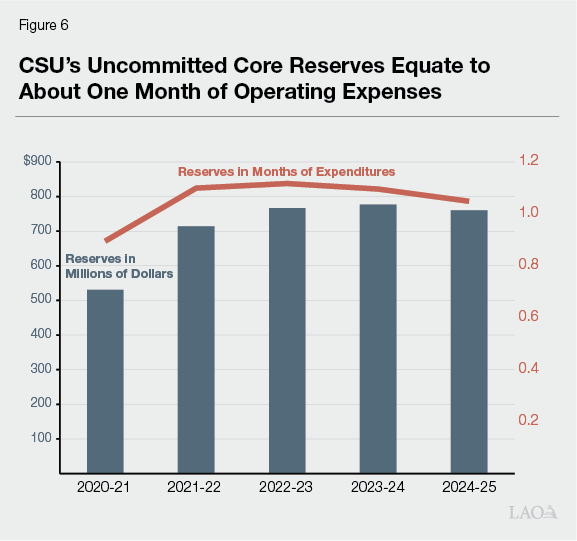
CSU’s Uncommitted Reserves Slightly Decreased in 2024‑25. Like many other universities (as well as public and private entities more generally), CSU maintains reserves. CSU commits part of its reserves for outstanding financial commitments and planned one‑time activities (such as launching a new academic program or designing a new capital project). CSU also leaves some of its reserves purposefully uncommitted to prepare for economic uncertainties, including recessions. As of June 30, 2025 (the most recent data available), CSU had $2.3 billion in total core reserves, of which $760 million was uncommitted. As Figure 6 shows, CSU’s uncommitted core reserves grew notably from 2020‑21 through 2023‑24, before declining slightly (by $17 million) in 2024‑25. CSU’s systemwide reserves policy sets a target to maintain uncommitted reserves worth between three and six months of expenditures. With its system reserve equating to only about one month of expenditures, CSU continues to fall below its target reserve.
Spending Trends
CSU’s Spending Is Driven by a Few Major Cost Pressures. In addition to understanding CSU’s reliance on state support and tuition revenue, it is important to understand CSU’s spending trends and core cost pressures. Understanding CSU’s spending trends is especially important when the state faces challenging fiscal situations. As discussed in The 2026‑27 Budget: Overview of the Governor’s Budget, the state faces projected deficits in the out‑years. As a result, budget makers will likely have to make difficult decisions in the coming years to realign state spending with available revenues. As part of that process, the Legislature may have to contemplate how to prioritize amongst competing state spending priorities.
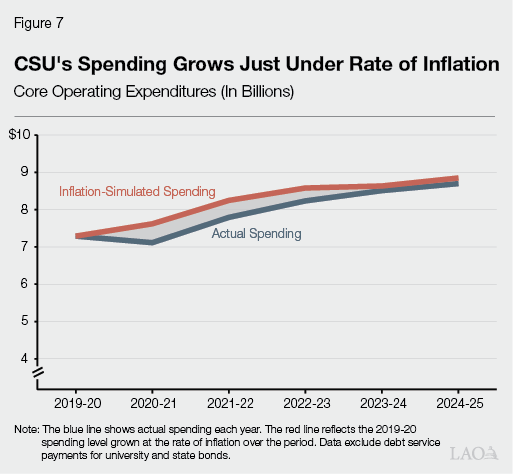
CSU’s Spending Generally Has Been Rising With Inflation. CSU’s spending for its core operating expenses increased from $7.3 billion in 2019‑20 to $8.7 billion in 2024‑25 (reflecting a 19 percent increase). Though spending has increased, as Figure 7 shows, it has not outpaced inflation. Specifically, in 2024‑25, CSU’s actual core spending was slightly lower than it would have been had it simply kept pace with inflation since 2019‑20. Overall, core spending at CSU has increased at an annual average rate of 3.6 percent over this period.
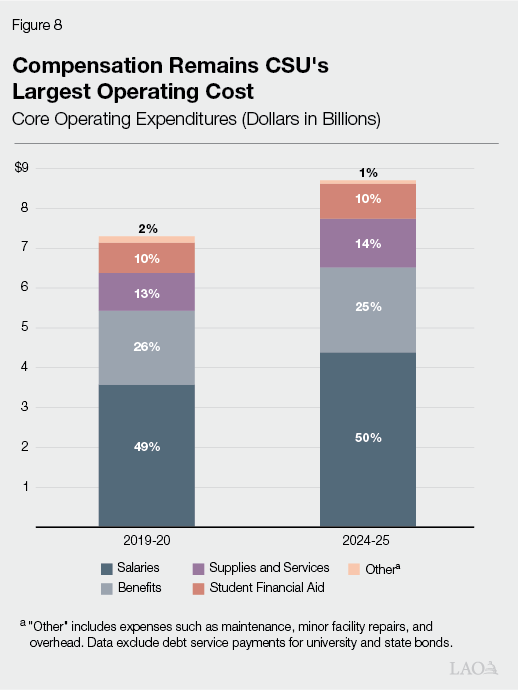
CSU’s Allocation of Spending Has Not Changed in Recent Years. Though CSU is spending more today than it did in 2019‑20, the allocation of spending across its core operating expenses has remained virtually the same. As Figure 8 shows, compensation (including salaries and benefits) continues to comprise the bulk of CSU’s core operating costs (75 percent). CSU’s next largest category of expenses is supplies and services (including information technology [IT] costs and contractual services, among other costs). Student financial aid comprises 10 percent of CSU’s core operating expenses. The remainder of this section examines several of these cost drivers in more detail.
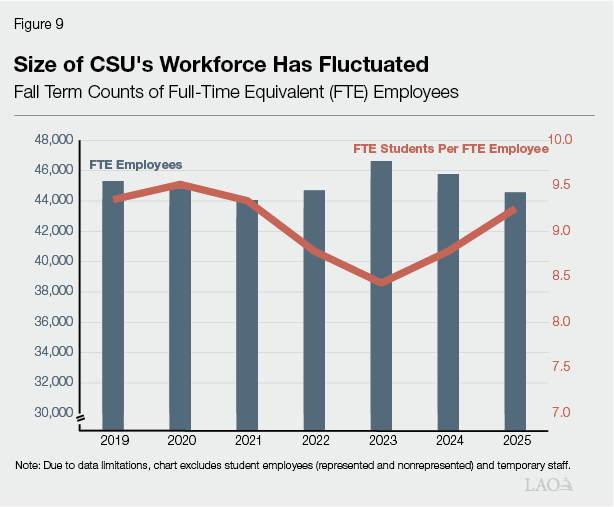
CSU’s Workforce Has Decreased the Past Two Years. In fall 2025, CSU had approximately 45,000 FTE employees. Of these employees, 43 percent are faculty, 47 percent are staff, and the remainder are managers and executives. As Figure 9 shows, the number of employees reached its highest level in fall 2023 but has since declined. As the number of FTE employees has declined the past two years while enrollment has increased, the number of FTE students per FTE employee ratio has increased. In fall 2025, the ratio was up to 9.3. Though rising, the ratio in fall 2025 was still slightly below what it had been in fall 2019.
From 2019‑20 to 2024‑25, CSU Has Provided Salary Increases Almost Every Year. State law authorizes the CSU Board of Trustees to ratify collective bargaining agreements for CSU’s employees. These agreements determine salary increases for represented employees and indirectly guide salary decisions for CSU’s nonrepresented employees. As Figure 10 shows, represented employees account for approximately 90 percent of CSU’s workforce. CSU’s spending for salaries increased by $805 million (23 percent) between 2019‑20 and 2024‑25, slightly outpacing inflation. The bulk of this spending increase is due to salary increases. In 2023‑24 and 2024‑25, CSU generally provided 5 percent salary increases. Salary negotiations for 2025‑26 are currently open for all unions. Nonrepresented employees, however, received one‑time salary increases in 2025‑26 (equivalent to 3 percent of their annualized salary as of November 2025). Represented employees were also offered this one‑time increase.
Figure 10
Two Unions Comprise the Majority of CSU’s Workforce
Share of Employee Headcount and Payroll by CSU Union, Fall 2025
|
Percent of CSU |
CSU |
|
|
California Faculty Association |
45% |
50% |
|
California State University Employees Union |
23 |
23 |
|
Academic Professionals of California |
6 |
6 |
|
Teamsters Local 2010 |
2 |
2 |
|
United Auto Workers |
15 |
—a |
|
Statewide University Police Association |
1 |
1 |
|
Union of American Physicians and Dentists |
—a |
—a |
|
International Union of Operating Engineers |
—a |
—a |
|
aLess than 0.5 percent. |
||
|
Note: Table excludes Executive and Management Personnel, Confidential Classes, Excluded Classes, nonacademic student employees, other intermittent employees, and faculty teaching in extension, special sessions, and summer sessions. |
||
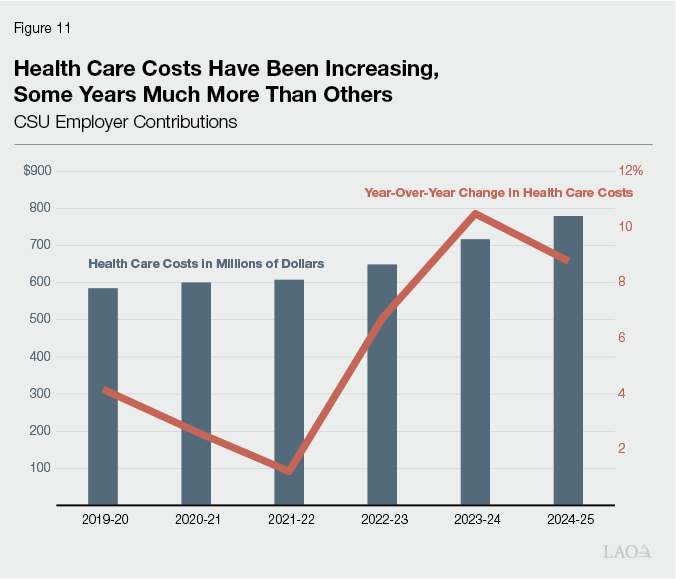
Growth in Employee Health Benefit Spending Has Accelerated Over Last Few Years. Increased spending on employee health benefits is also contributing to rising compensation costs. The California Public Employees’ Retirement System (CalPERS) administers CSU’s health benefits. Each year, CalPERS negotiates with health plan providers to establish premiums for the plans offered to CSU’s employees. Pursuant to state law, CSU’s contribution to employee health benefits is based on the average premium of the most popular health plans. When premiums increase, CSU covers the associated cost for its active employees. In contrast, the state covers the cost for retirees’ health benefits. As Figure 11 shows, CSU’s total spending on employee health care costs has been increasing over time, reaching $779 million in 2024‑25. Growth in health care costs has been particularly notable the past three years (with the highest growth in 2023‑24 at 10 percent).
Pension Contribution Rates Have Remained Relatively Flat in Recent Years. CalPERS additionally administers pension benefits for CSU and most other state employees. The CalPERS Board sets employer contribution rates for pensions as a percentage of payroll. The state pays costs for the employer contribution associated with CSU’s 2013‑14 payroll level. CSU pays the employer contribution for any payroll growth above that level. The state adopted this arrangement in 2013‑14 to provide CSU with a stronger fiscal incentive to contain staffing costs. CalPERS contribution rates increased every year from 2011‑12 through 2019‑20, rising from 18 percent to 31 percent over that period (for Miscellaneous Tier 1 state employees). In 2020‑21 and 2021‑22, the state applied certain supplemental payments towards CalPERS costs, which lowered rates to 29 percent. Since then, rates have generally stabilized around 32 percent.
Spending Increases for Financial Aid Are Primarily Due to Tuition Increases. CSU sets aside a portion of its tuition revenue to provide financial aid to students, also known as institutional financial aid. The largest institutional financial aid program is the State University Grant (SUG) program. SUG generally covers the full cost of tuition for students who have financial need (based upon a federal calculation) but do not receive tuition coverage under the Cal Grant program (such as students in their fifth or sixth year who have used up their four years of Cal Grant eligibility and some graduate students). Currently, SUG provides grants to about 150,000 students. Of the $879 million spent on financial aid in 2024‑25, 85 percent was for SUG. From 2019‑20 to 2024‑25, spending for institutional financial aid increased by $118 million (15 percent), largely as a result of tuition increases. When CSU increases its tuition charges, it intends to fully cover the higher charges for most SUG recipients. CSU has raised tuition three times over the last decade and has increased SUG spending to account for those associated increases. Starting in 2022‑23, the state requires CSU to also increase SUG spending for enrollment growth. This policy has also contributed to increased spending, but less so than the tuition increases.
Spending on Capital Renewal Has Been Increasing at Same Rate as Overall Budget. The main way CSU pays for large state‑approved capital projects is by issuing university bonds. Since 2014‑15, university bonds have been the main source of financing for CSU’s state‑supported facilities. Under this approach, CSU issues university bonds for academic capital projects, then pays the associated debt service from its main General Fund appropriation. From 2019‑20 to 2024‑25, CSU’s debt service for state‑approved projects grew from $295 million to $365 million (23 percent). (These amounts include debt service on university bonds as well as state bonds issued before 2014‑15.) CSU’s overall core budget also generally increased over this period, such that debt service as a share of total core funding hovered around 4 percent.
Proposals
Governor Proposes Base Increases for CSU. The Governor proposes to increase ongoing base General Fund support for CSU by $366 million (7 percent) in 2026‑27. This increase reflects two components. First, the Governor’s budget includes a 5 percent base increase ($265 million) for CSU in 2026‑27, reflecting the fifth‑year base increase of his multiyear compact. Second, the Governor’s budget includes an additional 2 percent increase ($101 million) associated with the 2025‑26 compact payment that was postponed under last year’s budget agreement. The administration proposes to give CSU discretion in allocating this additional funding in 2026‑27.
Governor Proposes to Continue Deferral Arrangement for One More Year. The 2025‑26 budget deferred a $144 million General Fund payment to CSU from 2025‑26 to 2026‑27 but allowed CSU to receive a no‑interest General Fund loan in the meantime. CSU requested and received this cash loan in fall 2025. The Governor’s budget proposes to continue this arrangement, deferring $144 million from 2026‑27 to 2027‑28, along with offering another no‑interest General Fund cash loan. The administration indicates it intends to retire the deferral in 2027‑28, incurring an associated one‑time cost of $144 million at that time.
Governor Maintains Out‑Year Funding Commitments. Under the Governor’s budget, the state would continue to make two additional out‑year funding commitments to CSU. The state would commit to providing CSU with a one‑time back payment of $252 million in 2027‑28 to address the base increase that it did not receive in 2025‑26. It also would provide CSU with its remaining 3 percent ongoing base increase ($151 million) associated with the 2025‑26 compact payment in 2028‑29.
CSU Anticipates Receiving Additional Tuition Revenue in 2026‑27. CSU estimates it will collect an additional $201 million in student tuition revenue in 2026‑27. Almost 90 percent of this increase ($176 million) is due to the planned rise in CSU’s tuition charges. Tuition charges are set at $6,838 for resident undergraduate students in 2026‑27, reflecting a $388 increase from 2025‑26. Additionally, CSU expects to generate $25 million in new tuition revenue from planned enrollment growth in 2026‑27. Of all the additional tuition revenue, CSU plans to use $67 million (33 percent) for SUG. (In addition, the California Student Aid Commission budget includes $53 million ongoing General Fund to pay for higher associated Cal Grant costs for CSU students in 2026‑27. Many CSU students with financial need receive full tuition coverage under the Cal Grant program.)
CSU Plans to Use Additional Funding for Its Various Spending Priorities. Under the Governor’s budget assumptions, CSU has $621 million in new ongoing core funding. After setting aside the portion dedicated for retiree health and pensions, CSU likely would use this additional funding to:
- Provide salary increases. The cost of a 1 percent salary increase is approximately $59 million.
- Cover cost increases related to active employee health benefits. Specifically, employee health premiums are expected to increase by $21 million in 2026‑27.
- Cover the cost associated with enrollment growth, particularly for the hiring of additional faculty and support staff. The total marginal cost (state and student shares combined) of increasing resident undergraduate enrollment by 1 percent in 2026‑27 is $58 million.
- Provide more funding for student financial aid. Specifically, CSU plans to designate $67 million for this purpose.
- Cover cost increases for utilities, liability and property insurance, and other inflationary cost pressures (including costs related to IT and contractual services).
- Provide ongoing funding for debt service to address capital renewal needs.
Assessment
Unrestricted Base Increases Lack Transparency and Accountability. The Governor’s proposed unrestricted base increase for CSU lacks transparency and accountability, as the funds are not earmarked for specific purposes. Although CSU’s 2026‑27 Operating Budget Plan provides some transparency by providing a spending plan, there is no statutory language that requires CSU to allocate the base increase consistent with this plan. Moreover, the Legislature could have different priorities—for example, prioritizing compensation increases versus enrollment growth differently than CSU.
Despite Large Increase in State Support, None Is Designated for Capital Renewal. CSU is carrying an estimated capital renewal backlog of $8.6 billion. If funding is not directed to address this backlog, more projects will be delayed and costs likely will increase as building components degrade further and lead to more significant facility issues. Though CSU has indicated that it plans to allocate $25 million of its base increase for debt service to fund capital renewal needs, the Governor gives CSU full discretion in deciding how to spend the proposed base increase. As a result, it could redirect some or all of this funding elsewhere due to competing spending priorities.
Governor Presents No Plan for How to Honor Out‑Year Commitments. The Governor’s budget continues to make out‑year funding commitments to CSU in fiscal years when the state is projected to have substantial General Fund deficits. Despite making these out‑year funding commitments, the administration has offered no plan for how to meet them (through new revenue, spending reductions in other areas, or other specific budget‑balancing actions). Without such a plan, CSU cannot be sure that the commitments will be honored, undermining the potential benefit of making the commitments in the first place.
Recommendations
Recommend Reducing or Eliminating Base Increases. When facing out‑year deficits, the Legislature typically considers ways to contain growth in state spending. The Governor, however, proposes to increase CSU spending significantly. In addition, the Governor’s budget does not specify how the historically large ongoing augmentations to CSU’s base funding would be supported in future years. Given this context, the Legislature could consider providing CSU with a smaller base increase that is more closely aligned with current inflationary benchmarks—such as the base increase of 2.41 percent proposed for community colleges. A smaller base increase would still allow CSU to cover some of its increasing costs. Additionally, it could provide more financial stability for CSU by mitigating the risk that the state would be unable to maintain the higher base moving forward. Alternatively, the Legislature could consider eliminating the proposed base increase for CSU altogether. This option makes the state’s structural deficit more manageable to address, increases the chances that core programs could be sustained moving forward, and reduces pressure for a more significant reduction in future years. Even with no increase in state support, CSU core funding would increase 4.2 percent due primarily to raising tuition charges, thereby still allowing CSU to cover some of its spending priorities. This growth is slightly above the average annual rate of growth in total core funding over the past ten years.
Recommend Earmarking a Share of Any Ongoing Base Increase for Capital Outlay. If CSU were to receive a base General Fund increase and designate none of it for capital improvements, its backlog would continue to grow, and facility conditions would worsen. To mitigate this issue, we recommend the Legislature adopt provisional budget language earmarking some share of any approved base increase for capital renewal projects to help campuses make progress on deferred maintenance and critical facility renewals. For example, earmarking around 10 percent of a base increase would allow CSU to undertake some projects while still having capacity to meet other spending priorities.
Recommend Using Available One‑Time Funding to Retire Payment Deferral. If one‑time funding becomes available, we recommend the Legislature retire this payment deferral either this year or in the coming years. Retiring the payment deferral would return CSU’s state payments to their regular schedule, eliminate the associated debt obligation, and reduce state budgetary pressures in the out‑years.
Recommend Removing Out‑Year Commitments. We recommend removing the state’s out‑year funding commitments to CSU in 2027‑28 and 2028‑29. Eliminating these out‑year augmentations would reduce projected state deficits in 2027‑28 and 2028‑29 without requiring programmatic cuts or tax increases. Rather than making commitments in advance, the Legislature could determine each year how much support it can afford to provide CSU in light of overall fiscal conditions and competing budget priorities.
Enrollment
In this section, we first provide background on CSU enrollment. Next, we cover enrollment trends. Then, we describe the state’s 2026‑27 enrollment expectations for CSU. Finally, we assess CSU’s enrollment situation and make associated recommendations.
Background
Most CSU Students Are California Residents. Approximately 95 percent of students at CSU are California residents, with the remainder of students coming from other states or countries. The share of resident students has hovered at about 95 percent over the past ten years. Some variation exists among campuses. In 2024‑25, the CSU Stanislaus student body had the highest share of resident students (99 percent), whereas CSU San Luis Obispo had the lowest share (85 percent).
CSU Is Important Part of Transfer Pipeline. Of resident students, nearly 90 percent are undergraduates (with the remainder postbaccalaureate and graduate students). Since at least the 1960s, the state has wanted to provide an opportunity for Californians to obtain a university education, if they so desire. To this end, any student (regardless of their high school performance) who successfully completes a course of study at a community college may transfer to a university for their upper‑division coursework. The state considers CSU a particularly critical part of this transfer pipeline. About 45 percent of CSU’s most recent incoming resident undergraduate fall class were transfer students. The rest of the incoming class entered as freshmen, with most having recently graduated high school.
State Budget Typically Sets Enrollment Growth Expectations for CSU. In most years, the state sets enrollment growth expectations for CSU in the annual budget act. These growth expectations apply to resident students. In some years, the state sets expectations for total CSU resident enrollment. In other years, it sets expectations only for resident undergraduates, with no expectation for resident graduate students. (The state does not set enrollment expectations for self‑supported courses, but we cover a related issue in the box nearby.)
Self‑Supported and State‑Supported Courses
CSU Offers Some Self‑Supported Courses. Like the other public higher education segments, the California State University (CSU) offers some self‑supported courses (also referred to as extended education or professional and continuing education). Self‑supported courses generally charge student fees intended to cover the full cost of the courses, without any state subsidy. Self‑supported course offerings include an array of academic courses, professional certificate programs, and personal enrichment courses offered throughout the year. In 2024‑25, CSU enrolled 22,217 full‑time equivalent (FTE) students in self‑supported courses. These students are not counted toward state enrollment targets. Historically, many campuses have chosen to offer some of their summer courses as self‑supported. Of the self‑supported FTE enrollment in 2024‑25, 36 percent was generated in the summer term.
CSU Has Been Shifting Some Summer Courses From Self‑ to State‑Supported. In recent years, CSU has shifted some of its summer courses from self‑supported to state‑supported. CSU indicates the courses shifted to state‑supported were generally academic courses that students took to make progress toward their degree. These include courses taken by continuing students as well as new students participating in summer transition programs. Data is not available on the specific courses that were shifted or the number of FTE students enrolled in those courses.
Enrollment Growth Continues to Be Overstated Due to Shift in Summer Courses. When the Legislature sets enrollment growth expectations for CSU in the state budget, it intends for CSU to add more students. CSU is reporting higher state‑supported enrollment. However, part of this increase has come from shifting enrollment from self‑ to state‑supported courses rather than adding new enrollment. As the figure below shows, summer enrollment increased in 2025‑26, but the number of students in self‑supported courses decreased (by 430 FTE). Though the decrease in the number of self‑supported students in 2025‑26 is smaller compared to the previous two years (4,705 FTE students in summer 2023 and 745 FTE students in summer 2024), CSU is still adding new state costs from shifting students formerly in self‑supported courses into state‑supported ones.
Number of Summer State‑Supported Students Has Been Increasing While the Number of Self‑Supported Students Has Been Decreasing
Resident Full‑Time Equivalent (FTE) Students, Summer Terma
|
2022‑23 |
2023‑24 |
2024‑25 |
2025‑26 |
Change From 2024‑25 |
||
|
Amount |
Percent |
|||||
|
State‑supported students |
5,660 |
11,295 |
12,777 |
14,927 |
2,150 |
16.8% |
|
Self‑supported students |
13,050 |
8,345 |
7,600 |
7,170 |
‑430 |
‑5.7 |
|
Totals |
18,710 |
19,640 |
20,377 |
22,098 |
1,721 |
8.4% |
|
aReflects annualized FTE resident students across all student levels. Summer is the first term of the college year. For example, summer 2025 enrollment counts towards 2025‑26. |
||||||
State Sometimes Sets Enrollment Expectations for Budget Year Plus One. Historically, the state sets an enrollment expectation for CSU in the budget year (for example, setting a 2016‑17 enrollment expectation in the 2016‑17 Budget Act). More recently, the state has set enrollment expectations for CSU in the budget year and budget year plus one. This change has reflected an effort by the state to better align its enrollment expectations with CSU’s admissions cycle. As CSU has already made many of its admissions decisions for the coming academic year by the time the Legislature enacts the annual budget in June, setting budget‑year expectations can be too late to have a notable impact on CSU’s behavior. In contrast, setting an expectation for budget year plus one allows the state to have more influence over CSU’s actions for the next academic year. Setting enrollment expectations for budget year plus one, in turn, gives CSU campuses more time to adjust their enrollment management practices to meet any new enrollment expectations set for them.
CSU Also Has Enrollment Targets Under the Governor’s Compact. In addition to the enrollment targets set forth each year in the annual budget act, CSU established a set of targets as part of the Governor’s compact. Under the compact, CSU planned to increase resident undergraduate enrollment by 1 percent annually (from 2023‑24 to 2026‑27). CSU does not track this target separately for undergraduates and graduate students. Under the compact, CSU is to cover the cost of enrollment growth using part of its 5 percent annual base increases. In 2025‑26, CSU kept its California resident student target flat at 390,598 FTE students given there was no associated compact funding that year.
State Funds Enrollment Growth According to Per‑Student Formula. Typically, the state supports resident enrollment growth at CSU by providing a separate General Fund augmentation based on the number of additional students CSU is to enroll. The per‑student funding rate is derived using a “marginal cost” formula. This formula estimates the cost of the additional faculty, support services, and other resources required to serve each additional student. Those costs are shared between state General Fund and student tuition revenue. In 2025‑26, the total marginal cost per student is $15,966, with a state share of $10,983. The formula calculates one rate that applies to all resident enrollment, whether at the undergraduate or graduate level. Whereas the state subsidizes the cost of educating resident students, nonresident students are charged a higher tuition rate that is intended to cover the full cost of their education.
Trends
CSU’s Enrollment Is Rebounding From Pandemic Declines. As Figure 12 shows, CSU’s total resident enrollment was generally trending upward from 2015‑16 through 2020‑21. CSU then experienced notable declines in its resident enrollment in 2021‑22 and 2022‑23. In 2022‑23, CSU enrolled approximately 30,000 fewer resident FTE students than a couple of years earlier. In recent years, CSU resident enrollment has been rebounding. CSU is expected to be almost back at its 2020‑21 peak enrollment level in 2025‑26.
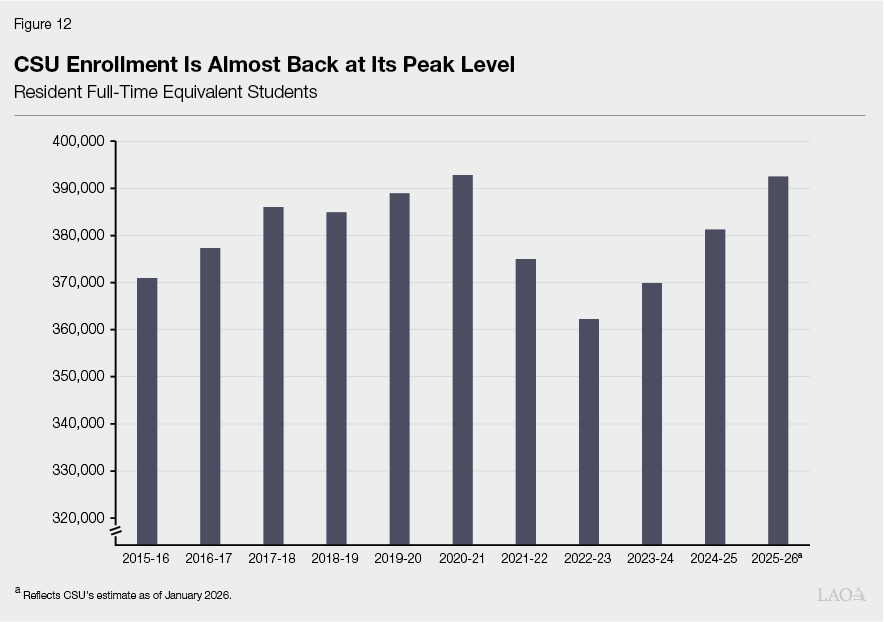
CSU Anticipates Exceeding Its 2025‑26 State Enrollment Expectation. The 2025‑26 Budget Act directed CSU to increase resident undergraduate enrollment by 7,152 FTE students, bringing its resident undergraduate enrollment level to 349,999 FTE students. This growth expectation is relative to CSU’s actual enrollment level in 2024‑25. CSU indicates it is on track to exceed the 2025‑26 state budget expectation—growing by 10,063 FTE students, for total resident undergraduate FTE students of 352,910. When combined with postbaccalaureate and graduate enrollment, CSU estimates enrolling a total of 392,500 resident FTE students in 2025‑26—an increase of 11,237 students (2.9 percent) from the previous year.
Fall Headcount Decreased for New Freshmen but Increased for Transfers and Continuing Students. Though the 2025‑26 college year is still underway, CSU has fall 2025 headcount data broken down by certain student groups. As Figure 13 shows, the number of new resident freshmen enrolled at CSU decreased 3 percent over the previous year. New transfer students increased by 1.8 percent. This is smaller than last year’s increase of 6.4 percent, which came after three years of declines in new transfer students (linked with declines in community college enrollment during the pandemic years). Though enrollment for new transfer students is recovering, it is still below its fall 2020 peak. Overall, the number of CSU undergraduates increased by 2.1 percent. This is higher than the increase in undergraduate students in fall 2024. The increase is primarily driven by the increase in continuing students (3.3 percent). This is the second year that the number of continuing undergraduates has increased since the pandemic. The increase in continuing students is likely due to rebounding after suppressed rates during the pandemic, as well as CSU’s strategic focus on increasing retention rates across student groups.
Figure 13
CSU Experienced Growth for All Student Groups but Freshmen
Resident Headcount, Fall Term
|
2023 |
2024 |
2025 |
Change From 2024 |
||
|
Amount |
Percent |
||||
|
Undergraduate |
|||||
|
New freshmen |
64,125 |
64,301 |
62,354 |
‑1,947 |
‑3.0% |
|
New transfer students |
47,613 |
50,641 |
51,574 |
933 |
1.8 |
|
Continuing students |
273,080 |
275,523 |
284,652 |
9,129 |
3.3 |
|
Subtotals |
(384,818) |
(390,465) |
(398,580) |
(8,115) |
(2.1%) |
|
Postbaccalaureate/Graduate |
45,194 |
47,028 |
50,023 |
2,995 |
6.4% |
|
Totals |
430,012 |
437,493 |
448,603 |
11,110 |
2.5% |
Campuses Vary in How Close They Are to Their CSU‑Determined Enrollment Targets. Beyond the budget‑act targets and compact targets, CSU tracks an internal “funded” target that it believes reflects the level of enrollment the state has funded. It allocates associated enrollment slots across its campuses, with campus‑specific targets based largely on previous enrollment trends and projected enrollment demand. Whether a campus meets its CSU‑determined enrollment target depends on several key factors, including regional demographic trends, competition with other campuses, program offerings, and enrollment management practices. As Figure 14 shows, enrollment trends vary among campuses, with 13 campuses failing to meet their 2024‑25 CSU‑determined enrollment targets, while 10 campuses exceeded them.
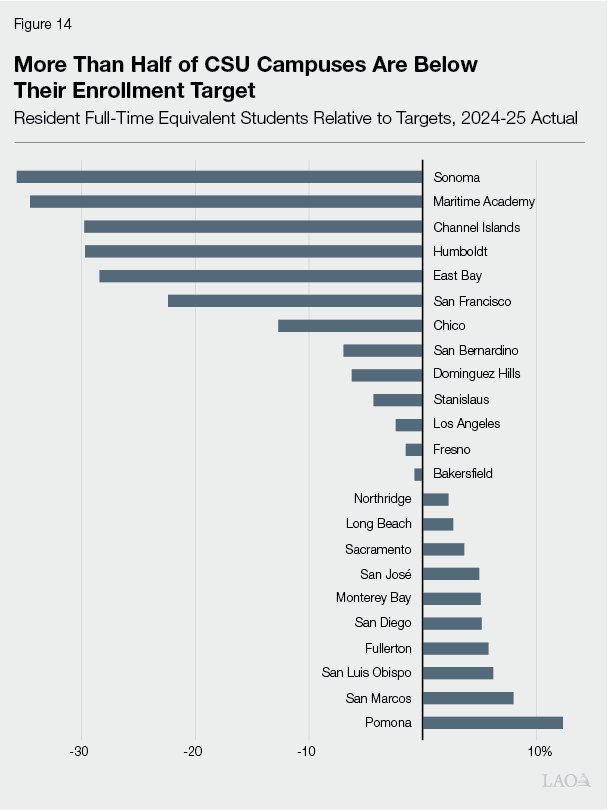
CSU Began Implementing an Enrollment Reallocation Plan in 2024‑25. To address these differences among campuses and work towards realigning funding with enrollment, CSU began implementing an enrollment reallocation plan in 2024‑25. Under the plan, CSU is gradually shifting slots and associated funding away from those campuses below their targets to those campuses above their targets. In 2024‑25, CSU shifted approximately 3 percent of funded slots away from 12 campuses below their enrollment targets to 7 campuses above their enrollment targets. A total of 3,891 FTE students ($32 million) were reallocated that year. In 2025‑26, CSU shifted another approximately 3 percent of funded slots away from ten campuses below their targets to nine campuses above their targets. A total of 3,397 FTE students ($32 million) are being reallocated this year. CSU intends to continue implementing this plan in 2026‑27—increasing the reallocation percentage to approximately 5 percent. In addition to providing funding through its enrollment reallocation plan, CSU provided one‑time funding of $20 million to seven campuses in 2024‑25 and $20 million to nine campuses in 2025‑26 that had enrollment above their target.
Number of “Impacted” Programs Is Decreasing. Historically, some CSU campuses and academic programs have been designated as impacted, meaning they have more student demand than enrollment slots. To manage student demand, impacted campuses and programs adopt stricter admissions criteria than the minimum systemwide eligibility requirements. Campuses may apply stricter admissions criteria to applicants outside their local service area and/or applicants within specific high‑demand programs. Currently, five CSU campuses (Fullerton, Long Beach, San Diego, San José, and San Luis Obispo) are impacted in all undergraduate programs. Other campuses tend to have at least a few programs impacted. For example, the Nursing Basic program is impacted on all 16 campuses where it is offered. Though some programs remain impacted, there has been a decrease in the number of programs impacted in recent years. From 2021‑22 to 2025‑26, the number of impacted programs across the CSU system declined from 333 to 233.
Proposal
Governor Maintains Enrollment Expectation for 2026‑27 but Sets No Target for 2027‑28. The 2025‑26 Budget Act set a resident undergraduate enrollment expectation for CSU in 2026‑27. Under those provisions, CSU is expected to add 10,161 FTE students in 2026‑27, bringing resident undergraduate enrollment to 360,160 FTE students. The Governor’s budget maintains this target. The Governor does not propose an enrollment growth target for 2027‑28.
Assessment
CSU Intends to Increase Enrollment in 2026‑27 but May Fall Short of State Target. CSU expects to surpass the 2025‑26 resident undergraduate enrollment target set forth in the 2025‑26 Budget Act by 2,911 FTE students. As a result, CSU will have to grow by fewer students to reach its 2026‑27 target. Specifically, CSU will have to increase resident undergraduate enrollment by 2.1 percent (rather than 2.9 percent) in 2026‑27. CSU, however, projects it will increase resident undergraduate enrollment by 1.4 percent. If the projections hold, CSU would end up 2,210 FTE students below the 2026‑27 state target.
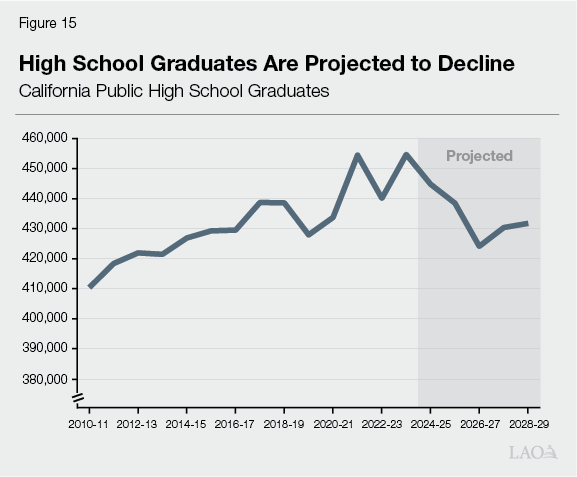
Demographic Trends Are Likely to Limit Growth in Out‑Years. One reason CSU might fall short of its existing enrollment target for 2026‑27 is because of demographic trends. Whereas CSU has seen increases in new freshmen over the past few years, the number of new freshmen decreased in fall 2025. The administration also projects that high school graduates will decrease by 1.4 percent in spring 2026, leading potentially to a decrease in the incoming freshman class for fall 2026. As Figure 15 shows, altogether from 2025‑26 through 2028‑29, the number of high school graduates is projected to decline by 1.5 percent. All else equal, this would translate to smaller new freshman cohorts in the out‑years.
Most CSU Campuses Are Already Meeting Student Demand. In the past, a key reason the Legislature has funded CSU enrollment growth was to expand access to eligible students who might otherwise not be admitted. This issue is less of a concern today. Over the past few years, admission rates have increased at nearly all CSU campuses. Fourteen campuses had freshman resident admission rates of 90 percent or higher in fall 2025, compared to only three campuses in fall 2019. The systemwide fall 2025 transfer admission rate of 89 percent is slightly lower (0.8 percentage points) compared to the prior year, but it is still higher than previous years. For example, from fall 2015 to fall 2018, the average admission rate for California resident transfer students was 78 percent. In addition, fewer programs are impacted.
CSU’s Enrollment Reallocation Plan Is Realigning Funding With Actual Students Served. Though a majority of CSU campuses are currently below their enrollment targets, some campuses are exceeding their enrollment targets. In 2024‑25, CSU began addressing this situation by reallocating existing enrollment slots from campuses under their enrollment targets to those exceeding their targets. Effectively, this reallocation moved funding internally within the CSU system to help support more enrollment growth at growing campuses.
Recommendations
Recommend Funding Lower Level of Enrollment Growth at CSU in 2026‑27. Given the state’s projected deficits, the Legislature faces difficult choices regarding what ongoing spending to prioritize in 2026‑27. In making those difficult decisions, within the higher education budget, we think there is a rationale to prioritize funding enrollment growth at CSU in 2026‑27. Providing funding for some enrollment growth would recognize the admissions decisions CSU already is in the midst of making. However, if the Legislature provides funding for enrollment growth, we recommend it set a lower growth target than established in the 2025‑26 Budget Act. Setting a lower growth target would acknowledge that CSU does not believe it can reach the higher proposed target. A lower growth target also would reflect the softer demographic pressures facing CSU. The state could, however, depart from its recent practice of including only resident undergraduates in its target. Instead, it could fund 1 percent growth of both resident undergraduate and graduate students, which would better align with CSU’s statutory mission to serve both groups of students.
Recommend Providing Enrollment Growth Funding Separately From Base Increases. Consistent with historical legislative practice, we recommend the Legislature fund enrollment growth at CSU apart from and on top of any base increase, as doing so provides greater transparency and accountability. (Relative to the Governor’s budget, the Legislature effectively could shift funding from the unrestricted base increase and designate it for enrollment growth.) We recommend the Legislature fund CSU enrollment growth using the marginal cost formula. Based on the 2026‑27 marginal cost state rate, the ongoing General Fund cost of 1 percent growth in resident enrollment (undergraduate and graduate combined) at CSU is $44 million. This is $38 million less than the cost under the Governor’s budget assumptions.
Recommend Holding Enrollment Flat in 2027‑28. Given the sizeable projected deficit in 2027‑28, we recommend holding enrollment expectations flat for CSU that year. This prevents CSU from being directed to enroll more students in the potential absence of associated funding. Setting enrollment targets for CSU but then not providing associated funding could negatively impact students through larger class sizes, fewer course offerings, and less academic support. Though the state would not be providing systemwide enrollment growth under this recommendation, CSU could still provide enrollment funding to growing campuses in 2027‑28 by continuing to shift funding under its enrollment reallocation plan. Furthermore, most campuses are already meeting student demand.