Rowan Isaaks

March 18, 2026
The 2026-27 Budget
California Competes Extension
Overview
California Competes Provides Incentives to Attract Business Investment. California Competes is an incentive program run by the Governor’s Office of Business and Economic Development (GO-Biz.) It provides nonrefundable tax credits to companies in exchange for a commitment to increase employment and investment in the state over several years. More specifically, the objective of the program is to influence a business’s decision to make investments in California that would have been made in another state, or not at all, absent the credit. GO-Biz negotiates individual agreements with each successful applicant, including year-by-year milestones and corresponding credit allocations. Agreements last for five years, by which time all employment and investment milestones must be achieved to claim the full credit amount. In addition, these milestones must be maintained for a further three years. Credits may be used to offset either personal income or corporation taxes and can be carried forward for up to six years. Over 1,200 credit agreements have been approved by GO-Biz since the program’s inception.
Fiscal Effect of Program Is Variable. Figure 1 shows the value of credits claimed each year since the program’s inception in 2014. Because applicants must provide sufficient evidence that the credit will influence their employment and investment decisions in the state, GO-Biz often does not award all tax credits available to be allocated in a given fiscal year. Therefore, although the program’s baseline annual allocation is $180 million, the fiscal effect of the program is liable to ebb and flow over time even if the size of the program does not. Additionally, limits on the use of tax credits by businesses will contribute to further fluctuations in the fiscal effect of the program in the current decade.
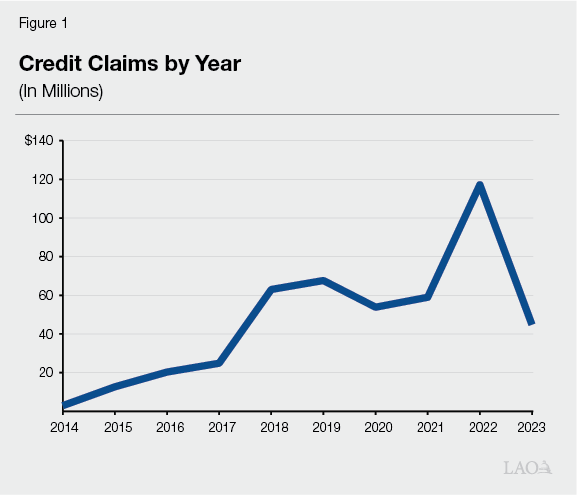
Parallel Grant Program Added in Some Years. Because the tax credit is nonrefundable, businesses without a significant California tax liability cannot benefit from the incentive it provides. Two types of businesses fall under this category. First, some firms lack tax liability in California due to ongoing and substantial use of other tax deductions and credits, most commonly the Research & Development Tax Credit and the Net Operating Loss deduction. Second, startup firms often experience losses for many years before turning a profit (if at all), potentially over the time frame that tax credits can be carried forward. To address this, the 2021, 2022, and 2023 budget acts each provided one-time funding of $120 million for a grant program to supplement the tax credit. The Governor’s budget proposals in 2024 and 2025 each included $60 million to fund the grant program but were not included in the final budget act due to projected deficits in those years.
Governor’s Proposal
Extend California Competes for an Additional Five Years. The Governor’s budget proposes to extend the California Competes Tax Credit program in its current form for an additional five years through fiscal year 2032-33.
Analysis
Program Trends
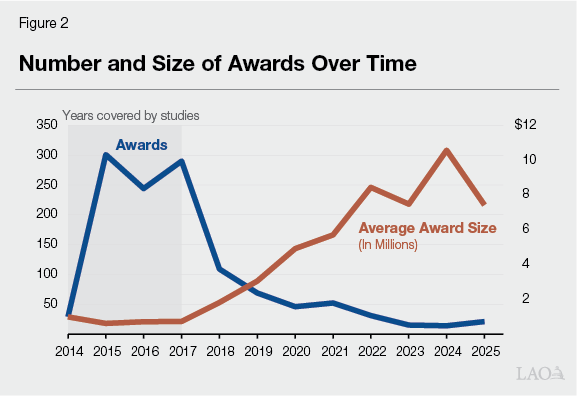
Award Characteristics Have Changed Over Time. While the characteristics of awards made by GO-Biz vary significantly within any given year, there has been a noticeable shift in the number and average size of awards over time: Figure 2 shows the number of awards made and the average credit amount per agreement for each year of the program. In earlier years, individual awards were much smaller and more numerous, whereas recent rounds have a much smaller number of awards that are typically worth several million dollars each. Changes made to the program in 2018 likely explain much of this trend. Specifically, the 2018 budget package:
Removed a requirement that 25 percent of credits be reserved for businesses with less than $2 million in annual revenue.
Required applicants to demonstrate that receiving the credit would influence their decision to create jobs in California.
Allowed GO-Biz to consider job training opportunities as a factor when awarding credits.
All three of these changes could have contributed to the trend shown in Figure 2 if (1) The 25 percent rule was favoring smaller businesses above better-qualified applicants from larger firms, (2) larger businesses provide better evidence on how the credit affects their decision-making, and (3) larger firms are more likely to have, or participate in, job training programs.
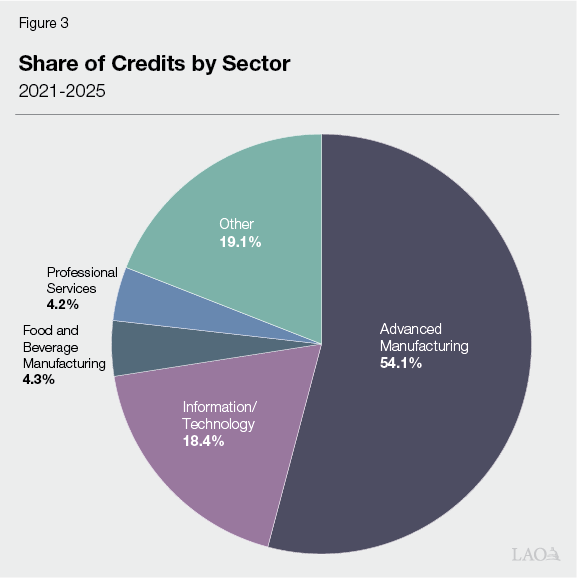
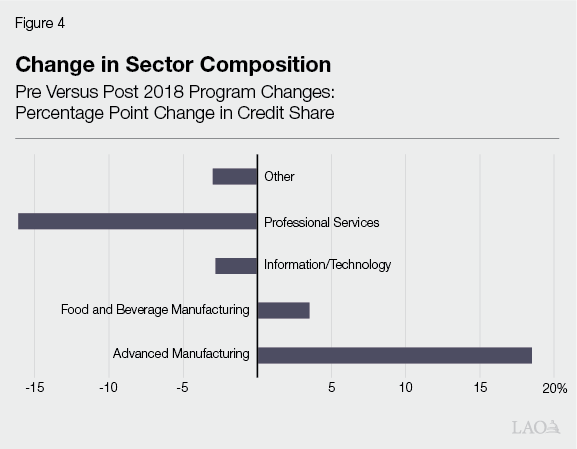
Industry Composition Reflects Intent of Program. Figure 3 shows how credits have been allocated across sectors over the last five years. Of the $1.2 billion in awards made between 2021 and 2025, around $650 million, or over half, has been allocated to businesses in advanced manufacturing. This category covers subsectors such as electronics and semiconductors, aerospace, battery technology, and biotechnology. The prominence of advanced manufacturers among credit recipients is consistent with the intent of the program, since (1) these types of facilities can locate in many parts of the United States, making tax incentives a potential deciding factor, and (2) they tend to provide relatively well-paid jobs, which increases the competitiveness of their applications. Figure 4 shows how credit allocation across sectors has changed since changes were made to the program in 2018. In particular, the share of awards going to advanced manufacturing firms has greatly increased while the share going to professional services (for example, accounting, legal, and local business services) has significantly decreased. This is especially consistent with the 2018 changes, since professional service firms tend to be classed as “non-tradeable,” meaning they are often already required to locate near their customer base, and thus tax incentives are unlikely to influence their decision to locate in California.
Research Evidence
Credit Design Has Favorable Components. California Competes has a few structural components that strengthen its effectiveness as an economic development tool. First, awards are allocated through a competitive application process rather than granted automatically based solely on eligibility. Second, the program combines quantitative performance metrics, such as the ratio of projected investment and job creation relative to the amount of credit requested, with qualitative assessments by program staff regarding whether the credit is likely to be a meaningful factor in the applicant’s decision to expand or locate in California. Together, these features help mitigate the so-called “windfall effect,” in which businesses receive incentives for activity that would have occurred absent the subsidy. Finally, agreements include recapture provisions that allow GO-Biz to reduce or reclaim credits if recipients fail to meet hiring or investment commitments.
Empirical Evidence Points to Effectiveness of Tax Credit for Job Creation. Recent evidence from academic research has found that the California Competes tax credit is relatively effective at increasing employment and providing an economic benefit to the state, especially relative to other tax expenditure programs in California and elsewhere. One study used detailed administrative data on applicants and awards to show that tax credit-supported projects are associated with positive employment effects in surrounding areas, consistent with net job creation rather than displacing other existing economic activity. Complementing this, another study compared similarly scored applicants where one received a credit and the other did not and found that recipient firms subsequently increased employment and payroll in California relative to otherwise similar firms that narrowly missed receiving an award.
2018 Changes to Program Could Impact Employment Effects. It should be noted that the empirical evidence for the program’s effectiveness is based on awards made in the first few years of the program (grey shaded area in Figure 2). Therefore, it is plausible that employment effects could be different in more recent rounds of the program. However, since the lag between the credit agreement and the outcomes of interest can be up to several years, we do not yet have the economic data to evaluate the most recent rounds of awards.
Credit Recapture and Recycling
Credits Can Be Reclaimed if Milestones Not Met or Maintained. All agreements between GO-Biz and credit recipients include a recapture provision: If a business fails to meet or maintain the job creation or investment milestones in their agreement, GO-Biz may disallow use of these credits or require repayment of credits already claimed.
Roughly Half of Credits Are Recaptured Historically. Figure 5 shows both the total value of awards made and the amount recaptured for each year of the program. For awards made between 2014 and 2020, the recapture rate is almost 55 percent. This indicates that around half of the net job increases and investments promised in negotiated agreements ultimately never come to fruition or are not maintained long term. Agreements that are less than five years old have not reached the end of their initial agreement period and thus have lower recapture rates (shown in the shaded grey area).
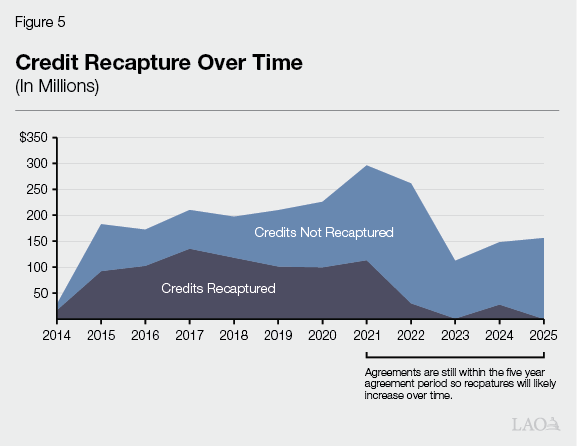
High Recapture Rate Can be Seen as a Feature… On one hand, high recapture rates can be seen as not a significant issue, and even a sign that the program is working as intended: Companies are incentivized by a tax break if they manage to achieve agreed-upon job and investment targets, but if they fail to do so, the state incurs no expense since the credit is never claimed or is paid back to the state. In other words, there is no explicit downside risk of making the award.
…But Also Indicates a Possible Trade-Off. However, there is a potential trade-off when considering awarding a credit to an applicant with a higher potential benefit to the state but a lower probability of achieving their milestones, compared to an applicant with a lower benefit but who is more likely to achieve their milestones. Program staff must weigh these possibly competing factors, and the high recapture rate could indicate a relative favoring of high-risk, high-rewards projects. In years where the program is fully subscribed, there is an opportunity cost associated with an agreement that is not fulfilled. Namely, those tax credits could have been awarded to another applicant who would have been more likely to achieve their milestones. However, as we discuss next, this has not been the case in the last few years of the program.
Recaptured and Unallocated Credits Can Be Recycled for Future Years. Although the current baseline allocation for the program is $180 million per fiscal year, the actual value of credits available to be allocated can be enhanced in two main ways: First, credits that are recaptured can be reallocated in future years. Second, any unawarded credits from the previous fiscal year can be added to the pool of available credits for the current fiscal year.
Credit Pool Has Ballooned to over $923 million for the Current Year. Consistently high recapture rates combined with a lower than usual award volume over the last few years has led to the rapid growth of the credit pool that now stands at $923 million.
Expanded Credit Pool Has Pros and Cons. On one hand, there is a clear strategic benefit to allowing the credit pool to increase beyond the baseline allocation: Changing macroeconomic conditions over the course of the business cycle means that there are years when businesses are more inclined to invest and expand operations than in other years. Having a large stockpile of credits allows GO-Biz to be flexible and take advantage of periods where there is a higher number of suitable applicants. If the yearly credit allocation was capped at $180 million, then the state could potentially miss the opportunity to incentivize projects with a positive return to the state. On the other hand, if GO-Biz chose to allocate a large fraction of the current credit pool over a short period, it would sharply increase the fiscal cost of the program over the next several years as credits are claimed.
Large Credit Pool Could Impact Program Competitiveness. Given the current size of the credit pool, the program is often undersubscribed, meaning that the value of credits allocated falls below the statutory cap. In these cases, any application that meets the program’s quantitative thresholds and is deemed by program staff to be of sufficient quality will typically receive a credit award. When the program is undersubscribed, however, fewer projects must compete for available credits. Compared with years when the program is oversubscribed, this may result in awards being made to projects that would not have been competitive in a more constrained funding environment. All else equal, this could lower the average economic return to the state. As a result, in undersubscribed years the judgment of program staff in determining which projects merit awards becomes especially important to the program’s effectiveness.
Recommendations
Approve Extension of California Competes. The program is conceptually well structured and has recent empirical evidence supporting the idea that the credit is leading to a net increase in jobs in the state. Therefore, we recommend that the Legislature approve the Governor’s proposal to extend the credit.
Consider Trade-Offs Associated With Growing Pool of Credits. If the Legislature is concerned about the potential for a short-term spike in the program’s fiscal costs, especially in light of the state’s structural budget issues, some modifications could be considered. Placing a limit on how quickly the pool of recycled credits can be drawn down could smooth increased fiscal impacts over a longer period. Alternatively, the total size of the California Competes credit pool could be capped to place an upper limit on the fiscal impact of a full drawdown.
Continue to Monitor Effectiveness. Since the evidence on the effectiveness of the credit is from earlier iterations of the program, and the attributes of awards have shifted over the years, periodic analysis of the program’s effectiveness as data becomes available continues to remain prudent.