
March 19, 2026
The 2026-27 Budget
Child Care and State Preschool
Summary
In this brief, we analyze the Governor’s child care and State Preschool budget proposals and provide associated recommendations. Below, we provide a summary of our major recommendations.
Recommend Aligning Child Care and State Preschool Increases. The Governor’s budget proposes suspending the statutory cost‑of‑living adjustment (COLA) for child care and State Preschool reimbursement rates and redirecting the savings associated with this suspension for an increase to the monthly cost of care plus payments. These payments supplement the existing reimbursement rates for all providers of subsidized child care and State Preschool. Under the Governor’s proposal, the state would calculate the increases separately for child care programs administered by the Department of Social Services (DSS), State Preschool programs operated by local education agencies (LEAs), and State Preschool programs operated by non‑LEAs. This approach would result in different monthly cost of care plus payments for these three groups of providers. Providing different rates by program runs counter to the state’s overall goal of transitioning to a single reimbursement rate structure that provides the same rates across programs. We recommend that any rate increases for child care and State Preschool be provided consistently for all programs.
Recommend Requesting More Information on Child Care Infrastructure Funding. The Governor proposes $11.5 million one‑time Proposition 64 funding to provide child care infrastructure grants to licensed child care providers impacted by recent wildfires. The administration has yet to provide key details, such as grant amounts, the allowable uses of funding, and time lines for when funding would be awarded. We recommend the Legislature request additional information from the administration regarding key elements of the infrastructure grant proposal. This information would allow the Legislature to determine whether the proposal is addressing key challenges with child care access in regions affected by wildfires.
Recommend Adopting General Child Care Reduction. The Governor’s budget proposes to reduce funding for General Child Care slots by $98 million relative to the 2025‑26 budget package. These reductions are mainly due to a decline in federal and Proposition 64 funding in 2025‑26 and 2026‑27 and would eliminate funding for approximately 4,200 slots. Given the state’s fiscal condition, we think this proposal is reasonable and recommend the Legislature adopt it. Based on current information, this reduction would not impact families currently receiving subsidized child care because the state has had unspent General Child Care funding in recent years.
Recommend Monitoring Unspent Program Funding. As we discuss in The 2026‑27 Budget: Overview of the Governor’s Budget, both our office and the administration project multiyear budget shortfalls beginning in 2027‑28, which will require the Legislature to make difficult spending decisions next year. We recommend the Legislature monitor the amount of unspent funding within the General Child Care program over the next few years. If additional unspent funds remain in the program, the Legislature could consider further reducing funding for General Child Care. Although reducing funding would run counter to the Legislature’s stated goal of increasing child care slots over the long term, this could help the state avoid reductions to other programs that would result in a reduction in the level of services provided to Californians.
Background
State Subsidizes Child Care, Primarily for Low‑Income Families. The state provides families with subsidized child care through various child care and development programs (Figure 1). Most of the state’s subsidized child care is administered by DSS through three programs: (1) California Work Opportunity and Responsibility to Kids (CalWORKs) child care, (2) the California Alternative Payment Program (CAPP), and (3) the General Child Care program. CalWORKs child care programs focus on families enrolled in or transitioning out of CalWORKs welfare‑to‑work activities. The remaining programs are primarily designed for low‑income, working families that have not participated in CalWORKs. Families are generally eligible for subsidized child care if they have a family income of less than 85 percent of the state median income ($93,418 annual income for a family of three and $108,237 annual income for a family of four in 2025‑26) and have a demonstrated need for child care.
Figure 1
Overview of Child Care Programs
|
Program |
Descriptiona |
Funded Slots |
|
CalWORKs Child Care |
Provides subsidized child care services to current and former CalWORKs families. Slots are available for all eligible children. |
160,414 |
|
California Alternative Payment Program |
Provides subsidized child care vouchers to eligible working families. Slots are limited to budget appropriation. |
170,495 |
|
General Child Care |
Directly contracts with center‑based and licensed family child care providers to serve working families eligible for subsidized care. Slots are limited to budget appropriation. |
61,048 |
|
Family Child Care |
Directly contracts with consortia of licensed family child care providers to serve working families eligible for subsidized care. Slots are limited to budget appropriation. |
3,400 |
|
Migrant Child Care |
Provides subsidized child care services to migrant families working in agriculturally related industries.b Services are provided throughout the Central Valley. Slots are limited to budget appropriation. |
5,054 |
|
Care for Children With Severe Disabilities |
Provides additional access to child care services for children under the age of 21 years and with exceptional needs.c Program is located in the San Francisco Bay Area. Slots are limited to budget appropriation. |
80 |
|
Emergency Child Care Bridge |
Provides temporary child care services to children in foster care system and under age 13. Child care services are temporary until family finds longer‑term child care solution.d |
3,245 |
|
aUnless otherwise specified, child must be under age 13 and families must earn at or below 85 percent of the state median income to be eligible for subsidized child care programs. For example, a family of three must earn less than $93,418 annually in 2025‑26 to be eligible for programs. bFamily earned at least 50 percent of their total gross income from employment in fishing, agriculture, or agriculturally related work during the 12 months immediately preceding the date of application for services. cChild must have an individualized education program or an individualized family service plan issued through a special education program. dChild care services provided up to 12 months, but may be extended for a compelling reason. |
||
State Also Provides State Preschool for Certain Children. State Preschool is administered by the California Department of Education and provided by a variety of local agencies and community‑based organizations. Three‑ and four‑year old children are generally eligible for State Preschool if their family earns at or below the state median income ($109,904 annual income for a family of three and $127,338 annual income for a family of four). State law includes various enrollment flexibilities that allow providers to serve families with higher incomes, and some providers may choose to serve eligible two‑year olds. Based on data from October 2024, the state serves 100,705 children in State Preschool.
Child Care and State Preschool Programs Supported With Multiple Funding Sources. The 2025‑26 budget package provided a total of $10.3 billion for subsidized child care and State Preschool ($7.8 billion from the General Fund). Of the total, the state provided $7.5 billion in funding for child care programs. The majority of child care funding ($4.9 billion) was from non‑Proposition 98 General Fund. The state also used roughly $2.3 billion in federal funding to partially cover program costs. In addition, the state partially covered program costs with $195 million from the Proposition 64 Youth Account, which is funded by the cannabis retail excise tax established in 2016. State Preschool programs are funded entirely with $2.9 billion in General Fund (including $1.9 billion in Proposition 98 General Fund). State Preschool programs offered by LEAs—school districts, county offices of education, community college districts, and certain charter schools—are funded with Proposition 98 General Fund. Those programs offered by non‑LEA providers (community‑based organizations, county welfare departments, and cities) are funded with non‑Proposition 98 General Fund.
Child Care Programs Must Comply With Certain Federal Requirements. Most of the federal funding the state appropriates for child care programs is provided through the Child Care and Development Fund (CCDF). States receiving CCDF funding must submit plans for approval to the federal Office of Child Care within the Administration for Children and Families. As a condition of receiving CCDF, the state must comply with a number of requirements, such as providing some matching funding as well as spending at least 12 percent of CCDF funds on quality improvement activities. In recent years, California made several changes intended to comply with changes to federal rules. For example, the 2025‑26 budget provided $30 million to support the transition to paying providers prospectively. (Currently, the state pays providers after they have submitted timesheets demonstrating they have provided care.) Additionally, starting in July 2026, the state will begin reimbursing providers who contract directly with the state (primarily General Child Care and State Preschool providers) based on enrollment rather than attendance.
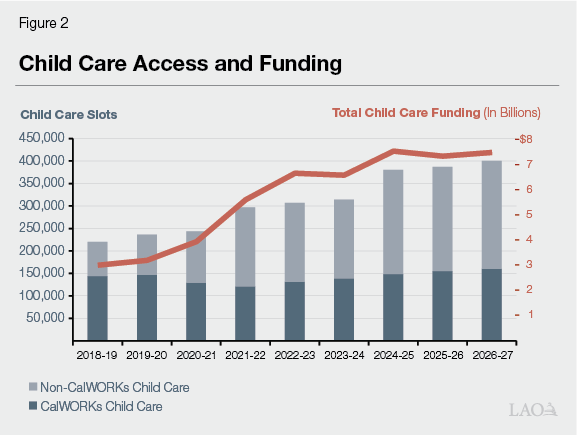
State Has Significantly Expanded Child Care Access and Funding Since 2021. As part of the 2021‑22 budget package, the Legislature and Governor agreed to add 206,800 non‑CalWORKs child care slots over a multiyear period. To date, the state has funded 129,800 additional slots—a 113.8 percent increase in non‑CalWORKs slots compared to 2020‑21 levels. CalWORKs caseload has also grown by over 31,000 (23.9 percent) over this period. Figure 2 shows the total number of subsidized child care slots, as well as total funding, since 2018‑19. Statutory intent language associated with the multiyear agreement would require an additional 44,000 slots in 2026‑27 and 33,000 in 2027‑28.
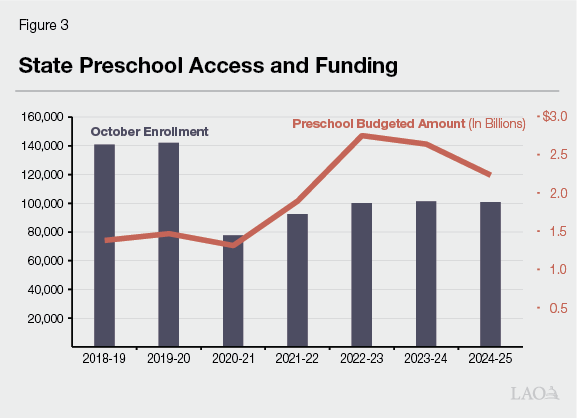
State Preschool Enrollment Below Pre‑Pandemic Levels as Funding Continued to Grow. As a result of the pandemic, State Preschool enrollment experienced a significant decline of roughly 65,000 students in 2020 (Figure 3). While enrollment has increased since 2020, it remains significantly below pre‑pandemic levels. In October 2024, State Preschool enrollment was roughly 40,000 students lower than October 2019 enrollment. Since the pandemic, the state has held providers harmless from enrollment declines. The hold harmless is set to expire June 30, 2026. Funding increases for State Preschool in 2021‑22 and 2022‑23 were primarily due to rate increases. In 2023‑24 and 2024‑25, the state made one‑time reductions to the program in recognition that funding provided exceeded the amount necessary to fund all State Preschool contracts.
Child Care and State Preschool Reimbursement Rates in Transition. The state has historically used two different reimbursement rates for child care providers—the Standard Reimbursement Rate (SRR) and the Regional Market Rate (RMR). In 2021, the state increased rates and shifted most providers to the RMR, then began the process of developing a new child care reimbursement rate structure for all child care and State Preschool providers. From 2023‑24 through 2025‑26, the state provided rate increases through monthly cost of care plus payments that supplement reimbursement rates for all providers. The state provides $1.1 billion in cost of care plus payments in the 2025‑26 budget, representing a 12.2 percent increase in total child care and State Preschool spending. The cost of care plus payments are allocated to providers based on their enrollment of children receiving subsidized child care. The rates per child are consistent across programs, but vary by region of the state and whether the provider is licensed. Funding for cost of care plus payments is intended to supplement existing reimbursement rates and be used to cover providers’ baseline operating costs as the state transitions to a new reimbursement rate structure.
State Has Statutory COLA for Child Care and State Preschool Providers. The state provides a statutorily required annual COLA—the same rate provided to K‑12 education programs—to child care providers funded on the SRR (mainly General Child Care and State Preschool providers). For voucher‑based programs that are funded based on the RMR (primarily CAPP), the state increases total program funding based on the statutory COLA, but does not automatically adjust provider rates. The increase in funding effectively allows CAPP to increase access to child care. In 2023‑24, the state redirected funding associated with the statutory COLA for all programs to cover costs of the monthly cost of care plus payments. In 2025‑26, the state used the estimated cost of the statutory COLA to provide a uniform increase in monthly cost of care plus payments to all providers. Trailer legislation associated with the 2025‑26 budget package also modified the way the state is to apply the statutory COLA. Starting July 1, 2026, all child care and State Preschool providers are required to receive a minimum annual rate increase equivalent to the statutory COLA.
California Previously Enacted the Child Care Infrastructure Grant Program. The state provided $351 million in the 2021‑22 budget package for infrastructure grants to child care providers. These grants included $201 million for minor repairs and renovations to child care facilities and $150 million for the construction of new facilities. The last of these funds are expected to be fully expended in 2025‑26.
Federal Government Attempted to Freeze Funding Used for Child Care. On January 6, 2026, the federal administration announced that it would freeze $10 billion in grant funding going to five states due to concerns about improper use of federal funds. The freeze affected Temporary Assistance for Needy Families (TANF), CCDF, and the Social Services Block grant. The 2025‑26 budget provides $1.1 billion from CCDF and $329 million from TANF for child care programs. On January 8, 2026, California and the other states sued to prevent the freeze. A federal court initially granted a temporary restraining order that was followed by a preliminary injunction, ordering that funds continue to be available pending resolution of the case.
Child Care and State Preschool Proposals
Governor’s Budget
Proposes $7.5 Billion for Child Care Programs in 2026‑27. The Governor’s budget includes $7.5 billion for child care programs in 2026‑27—an increase of $150 million relative to the revised 2025‑26 levels (Figure 4). This change includes a $175 million increase in non‑Proposition 98 General Fund, which is partially offset by a $14 million decrease in Proposition 64 funds and a $10 million decrease in federal funding. The latter reductions are primarily due to lower Proposition 64 revenues and the use of one‑time federal carryover funds in 2025‑26 (Figure 5).
Figure 4
Child Care Budget
(Dollars in Millions)
|
2024‑25 |
2025‑26 |
2026‑27 |
Change From 2025‑26 |
||
|
Amount |
Percent |
||||
|
Expenditures |
|||||
|
CalWORKs Child Care |
|||||
|
Stage 1 |
$614 |
$615 |
$630 |
$15 |
2% |
|
Stage 2d |
549 |
598 |
620 |
22 |
4 |
|
Stage 3 |
537 |
581 |
609 |
27 |
5 |
|
Subtotals |
($1,700) |
($1,794) |
($1,859) |
($65) |
(4%) |
|
Non‑CalWORKs Child Care |
|||||
|
Alternative Payment Program |
$1,990 |
$2,058 |
$2,058 |
— |
— |
|
General Child Caree |
1,495 |
1,510 |
1,487 |
‑$23 |
‑2% |
|
Bridge program for foster children |
107 |
62 |
62 |
— |
— |
|
Migrant Child Care |
79 |
79 |
79 |
— |
— |
|
Care for Children With Severe Disabilities |
2 |
2 |
2 |
— |
— |
|
Subtotals |
($3,672) |
($3,711) |
($3,688) |
($23) |
(‑1%) |
|
Support Programs |
$2,161f |
$1,825g |
$1,934h |
$109 |
6% |
|
Totals |
$7,533 |
$7,330 |
$7,481 |
$150 |
2% |
|
Funding |
|||||
|
Proposition 98 General Fundi |
$2 |
$1 |
$1 |
$0.04 |
4% |
|
Non‑Proposition 98 General Fund |
4,450 |
4901 |
5,075.50 |
175 |
4 |
|
Proposition 64 Special Fund |
639 |
$199 |
184 |
‑14 |
‑7 |
|
Federal |
2,442 |
2,230 |
2,220 |
‑10 |
— |
|
aReflects 2025‑26 May Revision estimates with LAO adjustments. bReflects 2026‑27 Governor’s Budget estimates with LAO adjustments. cReflects 2026‑27 Governor’s Budget with LAO adjustments. dDoes not include $4.4 million provided to community colleges for certain child care services. eIncludes funding for family child care home education networks. fIncludes cost estimates for quality programs, child care infrastructure, Child and Adult Care Food Program, CCPU Training Fund, CCPU Retirement Benefit Trust, CCPU Health Benefit Fund, accounts payable, whole child community equity, court cases and costs associated with 2023‑24 MOU and parity agreement. gIncludes cost estimates for quality programs, child care infrastructure, Child and Adult Care Food Program, accounts payable, prospective pay, reimbursement based on certified need, rate reform support, administrative support, and whole child community equity. The budget authorizes the Department of Finance to increase spending by up to $195 million on CCPU funds for retirement, health, and training. hIncludes cost estimates for quality programs, child care infrastructure, Child and Adult Care Food Program, accounts payable, prospective pay, reimbursement based on certified need, administrative support, low income investment fund, whole child community equity, and the child care COLA. The budget authorizes the Department of Finance to increase spending by up to $195 million on CCPU funds for retirement, health, and training. iReflects Proposition 98 funds for Child and Adult Care Food Program. |
|||||
|
CCPU = Child Care Providers United; MOU = memorandum of understanding; and COLA = cost‑of‑living adjustment. |
|||||
Figure 5
Changes in Child Care Spending
(In Millions)
|
General Fund |
Prop. 64 |
Federal |
Total |
||
|
Prop. 98 |
Non‑Prop. 98 |
||||
|
Policy Changes |
|||||
|
Cost of care plus increase in lieu of COLA |
— |
$88 |
— |
— |
$88 |
|
Infrastructure grants for wildfire affected areas |
— |
— |
$12 |
— |
12 |
|
General Child Care reductiona |
— |
5 |
‑26 |
‑$2 |
‑23 |
|
Subtotals |
(—) |
($93) |
(‑$14) |
(‑$2) |
($77) |
|
Technical Adjustments |
|||||
|
Annualization of monthly cost of care plus payments |
— |
$197 |
— |
— |
$197 |
|
CalWORKs caseload and cost of care |
— |
55 |
— |
$10 |
65 |
|
Child and Adult Care Food Program caseload and COLA |
$0.04 |
0.2 |
— |
24 |
25 |
|
Annualization of prospective pay costs |
— |
14 |
— |
— |
14 |
|
One‑time adjustmentsb |
— |
‑21 |
— |
‑42 |
‑63 |
|
Expiration of one‑time stabilization payment |
— |
‑163 |
— |
— |
‑163 |
|
Subtotals |
(—) |
($81) |
(—) |
(‑$8) |
($74) |
|
Totals |
$0.04 |
$175 |
‑$14 |
‑$10 |
$150 |
|
aThe Governor’s budget also includes a $75 million reduction in federal funding beginning in 2025‑26. bIncludes prior year one‑time costs associated with quality carryover, child care infrastructure carryover, court cases, and the whole child community equity program as well as the COLAs for Resource and Referral and Local Planning Councils. |
|||||
|
COLA = cost‑of‑living adjustment and CCPU = Child Care Providers United. |
|||||
Includes Spending Increases for Two Proposals. The Governor’s budget proposes suspending the statutory COLA for child care providers and redirecting the savings associated with this suspension ($87.8 million non‑Proposition 98 General Fund) to increase the monthly cost of care plus payments for all child care and State Preschool providers. We estimate this increase equates to a nearly 11 percent increase to monthly cost of care plus payments. In addition, the budget includes $11.5 million from Proposition 64 funds to provide child care infrastructure grants that would target current licensed centers and family child care homes that reported operational impacts associated with recent wildfires.
Reduces General Child Care Slots by $98 Million Relative to 2025‑26 Budget Package. The Governor’s budget includes a $75 million ongoing reduction to General Child Care in 2025‑26, which is due to a decrease in California’s CCDF award. For 2026‑27, the Governor’s budget proposes to reduce total General Child Care funding by an additional $23 million ongoing. This reduction consists of a $26 million decrease associated with lower Proposition 64 revenues and a $2 million decrease in federal funding, partially offset by a $5 million increase in non‑Proposition 98 General Fund. These reductions would effectively eliminate funding for roughly 4,200 General Child Care slots that were added to the budget in recent years. Funding for these slots has not yet been contracted to providers.
No New Child Care Slots for Implementation of Multiyear Expansion Plan. The Governor’s budget does not include additional child care slots to continue the multiyear slot expansion plan. Under the statutory intent language, the state would be required to add 12,000 General Child Care slots and 32,000 CAPP slots in 2026‑27. Not adding these slots saves approximately $336 million non‑Proposition 98 General Fund in 2026‑27.
Provides $3 Billion for State Preschool. Of this amount, $2 billion is Proposition 98 General Fund for programs offered by LEAs and $1 billion is for programs offered by non‑LEAs. Overall, as Figure 6 shows, the Governor’s budget increases State Preschool funding by $136 million compared to 2025‑26. Similar to the proposal for child care, the Governor’s budget proposes suspending the statutory COLA for State Preschool providers and redirecting the savings associated with this suspension ($46 million Proposition 98 General Fund and $24 million non‑Proposition 98 General Fund) for an increase to the monthly cost of care plus payments. The specific increase would be calculated separately for LEA and non‑LEA providers. The remaining changes are technical adjustments related to one‑time savings and spending in 2025‑26.
Figure 6
2026‑27 Changes in Preschool Spending
(In Millions)
|
Change |
General Fund |
Total |
|
|
Prop. 98 |
Non‑Prop. 98 |
||
|
Restoration of one‑time State Preschool reduction |
$81 |
— |
$81 |
|
Cost of care plus increase in lieu of cost‑of‑living adjustment |
46 |
$24 |
70 |
|
Removal of one‑time 2025‑26 spending |
— |
‑16 |
‑16 |
|
Totals |
$127 |
$9 |
$136 |
Assessment
Increases in Lieu of COLA Will Be Higher at May Revision. Based on conversations with DSS, our understanding is that the cost of providing funding in lieu of the COLA will be higher at May Revision. This is because the estimates included in the Governor’s budget inadvertently did not account for the costs of providing a COLA to CalWORKs child care and the Emergency Child Care Bridge program. We estimate addressing this issue would increase the costs of the Governor’s proposal by about $45 million.
COLA Approach Would Provide Different Increases to Child Care and State Preschool Providers. Under the administration’s proposal to redirect COLA funding to an increase in monthly cost of care plus payments, the state would calculate the increases separately for child care programs administered by DSS, LEA State Preschool providers, and non‑LEA State Preschool providers. As Figure 7 shows, this approach would result in different monthly cost of care plus payments for these three groups of providers. These differences are primarily driven by differences in per‑child funding rates across programs. This approach runs counter to the state’s overall goal of transitioning to a single reimbursement rate structure that provides the same rates based on specific criteria, such as child age groupings and regional costs. It is also counter to the approach taken in 2025‑26 to provide a uniform increase to monthly cost of care plus payments for all providers.
Figure 7
Governor’s Proposal Creates Disparities in Cost of Care Plus Payments
Rates for Licensed Providers
|
Provider Type |
2025‑26 Rates |
LAO Estimates |
|
Child Care |
$152‑$230 |
$177‑$268 |
|
State Preschool (LEA) |
152‑230 |
181‑274 |
|
State Preschool (Non‑LEA) |
152‑230 |
184‑278 |
|
Notes: Cost of Care Plus rates vary by region. |
||
|
LEA = local education agency. |
||
Few Details on Child Care Infrastructure Grant Proposal. The administration has indicated the infrastructure grant proposal is intended to support current licensed centers and family child care homes that reported operational impacts associated with recent fires. However, the administration has yet to provide other key details, such as grant amounts, the allowable uses of funding, and time lines for when funding would be awarded. This lack of detail makes it difficult for the Legislature to evaluate the merits of the proposal.
New General Child Care Slots Still in Process of Being Filled. Compared with voucher‑based slots, General Child Care slots take time to award, contract, and fill. The state typically takes several months to develop a request for applications, review applications, and award funding. In addition, it typically takes DSS several months to finalize and execute a contract once new General Child Care expansion funds are awarded to providers. The length of time to execute a contract can be delayed for several reasons, including delays at DSS and challenges providers have in completing the requirements to be fully licensed to serve children. As a result of these delays, the state has had unspent General Child Care funding in recent years. In 2024‑25, $446 million in General Child Care funding went unspent. Although total unspent funding for 2025‑26 is not yet available, as of January 2026, approximately $170 million in funding from the most recent slot expansion has not yet been contracted. Some of these slots will likely be contracted by July, but the state is likely to have additional unspent funds for 2025‑26.
Reasonable Not to Add Slots or Backfill General Child Care Given State Budget Condition. The Governor’s budget would reduce the amount of funding available for General Child Care slots to align with lower Proposition 64 revenues and CCDF. This approach differs from recent years, when the state has used General Fund to backfill for lower Proposition 64 revenues. Given the budget challenges facing the state, we think the Governor’s proposal is reasonable. As we discuss in The 2026‑27 Budget: Overview of the Governor’s Budget, both our office and the administration project multiyear budget shortfalls beginning in 2027‑28, which will require the Legislature to make difficult spending decisions next year. Making ongoing reductions to General Child Care funding would help reduce the structural deficit moving forward. In the coming months the state will have additional information regarding the amount of funding that has not yet been contracted to providers. This will help the Legislature determine whether the proposed reduction could be implemented now without directly affecting families. Additionally, we think it is reasonable for the state to pause the slot expansion plan specified in the statutory intent language. Adding these slots would cost the state $336 million non‑Proposition 98 General Fund in 2026‑27 and add to the state’s projected structural deficit in future years.
Proposition 64 Revenue Likely Higher Than Governor Projects. In our recent post, Cannabis Tax Revenue Update (2025 Q4), we project Proposition 64 revenues for 2025‑26 will be 5.9 percent higher than estimates included in the Governor’s budget. These higher revenue estimates would result in an additional $17 million that would be available for child care. The administration will update its Proposition 64 revenue estimates at May Revision.
Federal Government May Modify Prospective Pay Requirements. The federal government is currently considering a proposed rule change that would remove the requirement to pay child care providers prospectively. Under the proposed rule change, states would be allowed, but not required, to pay providers prospectively. If the federal government approved the rule change and the state chose to maintain its existing practices and no longer shift to prospective pay, it could save $43.8 million in ongoing non‑Proposition 98 General Fund (the amount currently budgeted to increase staffing to make payments prospectively and “true‑up” payments after receiving actual enrollment data).
Recommendations
Align Child Care and State Preschool Increases. To avoid creating more discrepancies in funding, we recommend that any rate increases for child care and State Preschool be provided consistently for all programs. For example, if the Legislature adopts the Governor’s proposal to increase monthly cost of care plus payments, we recommend applying the same increase to all providers. Mirroring the approach taken in previous years, which pooled COLA funding across all programs, would be a cost neutral change.
Request More Information on Child Care Infrastructure Funding. We recommend the Legislature request additional information from the administration regarding key elements of the infrastructure grant proposal, such as the process for receiving funding, award amounts, and allowable uses. This information would allow the Legislature to determine whether the proposal is addressing key challenges with child care access in regions affected by wildfires.
Adopt General Child Care Reduction. We recommend the Legislature adopt the proposal to reduce General Child Care funding to align with lower Proposition 64 revenues and CCDF. The exact amount of this reduction will depend on final Proposition 64 revenues. Based on current information, this would not impact families currently receiving subsidized child care. To help the Legislature determine how much the state could reduce without directly affecting families, we recommend requiring DSS to report at May Revision hearings on the amount of funding they estimate is necessary to serve families currently receiving subsidized child care for 2025‑26 and 2026‑27.
Monitor Unspent Program Funding. We recommend the Legislature monitor the amount of unspent funding within the General Child Care program over the next few years. If additional unspent funds remain in the program, the Legislature could consider further reducing funding. Although reducing funding would run counter to the Legislature’s stated goal of increasing child care slots over the long term, this could put the state in a better fiscal position over the next few years and help the state avoid reductions to other programs that would result in a reduction in the level of services provided to Californians.