Ann Hollingshead
For detail about specific budget areas, see the California Spending Plan Series.

August 26, 2026
The 2026-27 Budget
Overview of the Spending Plan
Introduction
Each year, our office publishes the California Spending Plan to summarize the annual state budget. In this publication we provide an overview of the 2026‑27 budget package, give a brief description of how the budget process unfolded, and then highlight the major features of the budget approved by the Legislature and signed by the Governor. This publication reflects the administration’s estimates of legislative actions taken through the end of June 2026. In addition to this report, we will release a series of issue‑specific, online posts that give more detail on the major actions in the budget package.
Budget Choices
In most years, we would describe the size of the budget problem (or budget surplus) the Legislature addressed (or allocated) and the mix of choices that make up that total. This year, neither framing fits the budget package as neatly. Although the budget package includes some traditional budget solutions, it also reflects a substantial amount of new discretionary spending and a large, first‑time deposit into a surplus holding account. Taken together, these choices roughly offset one another. At the same time, the budget continues to rely on reserve capacity, even as revenues have surged to levels only surpassed by the state’s previous peak in 2021‑22. Taken altogether, this makes the budget condition difficult to describe concisely. As such, this section describes the state’s budget choices on both sides of the ledger: first new commitments and discretionary choices, and then the budget solutions made.
New Commitments
Revenue and Spending Commitments
New Discretionary Spending Totals Nearly $6 Billion. The budget commits $5.7 billion in new, discretionary General Fund money in 2026‑27. We define discretionary spending as new spending or revenue reductions that were not previously authorized under current law or legislative policy. Nearly all of these commitments are spending related—revenue reductions account for only about $25 million of the total, mainly a temporary reduction in the minimum franchise tax for newly formed businesses. For context, this new discretionary spending is equivalent to roughly 90 percent of the total year‑over‑year growth in General Fund spending between 2025‑26 and 2026‑27. A list of the discretionary General Fund spending actions (excluding Proposition 98 (1988)) in the 2026‑27 budget package are listed in Appendix 1.
Most New Spending Is One Time, but the Budget Also Added New Ongoing Costs. Of the $5.7 billion in new discretionary spending, about $5 billion (87 percent) is one time, while the remaining roughly $700 million reflects ongoing commitments—costs that will recur as part of the budget’s baseline in future years. On a fully phased‑in basis, these will total about $825 million annually. This new ongoing spending is a relatively small share of the total. Nonetheless, it adds to the budget’s baseline costs in future years, offsetting the solutions described elsewhere in this report that were used to address the gap between the state’s ongoing revenues and expenditures.
New Spending Is Concentrated in Health, Though New Spending Touches Nearly Every Program Area. With over 250 individual items, new discretionary spending reaches nearly every part of the budget, but on a programmatic basis, health programs account for the largest share (nearly 40 percent of the total), followed by general government, labor, and related programs (15 percent); housing and homelessness (12 percent); and criminal justice (11 percent). Human services and resources and environment programs each account for about 8 percent to 9 percent, with the remainder split between higher education (3 percent), K‑14 education (excluding Proposition 98) (2 percent), and transportation (1 percent). Within health, the largest commitments are two one‑time actions that delay previously planned reductions to Medi‑Cal safety net clinic and dental payments ($1 billion and $258 million, respectively), along with $361 million for dental benefits for adults with unsatisfactory immigration status (UIS) and $250 million in public hospital grants. Other large individual commitments outside of health include: (1) $400 million for the Homeless Housing, Assistance and Prevention program (HHAP); (2) $228 million for new child care slots, plus $112 million to increase the child care monthly cost of care; (3) $200 million for the Multifamily Housing Program; and (4) $150 million each for the Community Air Protection Program and judicial branch deferred maintenance. Beyond these larger items, the remainder of the new augmentations consist of many smaller commitments—the median item is about $5 million—reflecting a broad range of initiatives.
Discretionary Reserves and Set Asides
Sets Discretionary Reserve Balance to $4.5 Billion. The Special Fund for Economic Uncertainties (SFEU) is a general‑purpose reserve commonly used to provide capacity for unanticipated expenditures, including state costs associated with disasters and other emergencies. On a technical basis, it can be thought of as the end balance of the state’s General Fund—the money that remains after accounting for all of the state’s expected revenues and spending. The State Constitution has a balanced budget requirement, which means the balance of the SFEU must be set at zero or above for the upcoming fiscal year (2026‑27). Any level above that is up to the discretion of the Legislature. As a result, we consider the entire balance of the SFEU to be a discretionary choice. The budget sets the SFEU balance at $4.5 billion, in line with recent budgets, which have set the balance between $3.5 billion and $4.5 billion.
Makes $6.4 Billion Transfer to Temporary Surplus Holding Account (TSHA). The budget package deposits $6.4 billion into the TSHA, to be withdrawn in 2027‑28. Importantly, neither our office nor the Department of Finance considers this account to be a reserve. That is because, while it can help the state manage surging revenues within the budget window, it cannot mitigate against a future downturn in revenues. The box below describes this account and the transfer in more detail.
What Is the Temporary Surplus Holding Account (TSHA)?
Revenues Are Both Volatile and Uncertain. State revenues are volatile—they can grow or shrink rapidly from year to year, particularly because California’s tax system relies heavily on high‑income taxpayers. This means that, in some years, the state will collect significantly less in tax revenue than needed to cover its spending commitments—resulting in large budget problems. Relatedly, there is significant uncertainty about near‑term revenue estimates—that is, even for the upcoming fiscal year, revenues can come in significantly above or below projections, resulting in large forecasting errors. This is especially common when revenues are growing or shrinking rapidly.
TSHA Was Set Up to Avoid Overspending a Surplus. In 2024, the Legislature created the TSHA as a tool intended to manage near‑term revenue uncertainty. The account was designed for periods when the state has a surplus driven by rapid revenue growth and might otherwise commit to new spending based on revenue estimates that later prove overstated. The Legislature initially considered establishing formulas or rules governing deposits into the account. Ultimately, however, the TSHA was enacted as a flexible and largely discretionary mechanism.
Budget Uses TSHA for the First Time. The 2026‑27 budget package deposits $6.4 billion into the TSHA and plans to withdraw the same amount in 2027‑28. (By law, funds can remain in the account for up to one year.) In effect, this transfer uses anticipated 2026‑27 resources to help balance the following year’s budget, rather than allocating those resources to new purposes in the current budget window.
Budget Solutions
The state has several types of solutions—or options—for addressing a shortfall between resources and costs, but the most important include: reserve withdrawals, spending reductions, revenue increases, and borrowing (for example, loaning money from other funds to the General Fund).
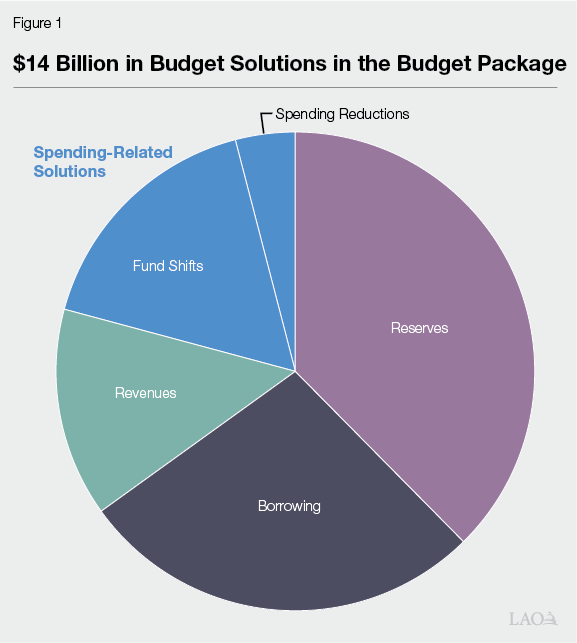
Budget Package Included $14 Billion in Budget Solutions. The budget package includes about $14 billion in budget solutions. This total is essentially the same as the amount in the Governor’s May Revision (also $14 billion). Figure 1 summarizes the solutions that the budget package used. As the figure shows, the budget primarily relies on reserves and borrowing, which together represent about two‑thirds of total solutions. Spending‑related solutions—reductions and fund shifts—represent about $3 billion, or roughly one‑fifth of the total. Revenue‑related solutions, at $2 billion, represent the remainder. This section provides additional detail on each category of solution. Appendix 2 lists all the budget solutions.
Reserves ($5 Billion)
Nearly 40 percent of the budget’s solutions are achieved by suspending an otherwise required reserve deposit—$5.4 billion. This is the single largest category of solutions in the budget package.
Suspends Budget Stabilization Account (BSA) True‑Up Deposit of $5.4 Billion. Proposition 2 (2014) outlines the formulas by which the state must, each year, make deposits into the BSA, unless those requirements are suspended under a budget emergency. Proposition 2 also requires the state to revisit—or “true up”—its estimates of BSA deposits twice: once in each subsequent fiscal year. These true ups are required even if the initial deposit was suspended; however, true ups can themselves be suspended, as well. The state already suspended a $1.6 billion initial deposit for 2025‑26. Under the administration’s revenue estimates, an additional $5.4 billion true‑up deposit was otherwise required for that year. The budget package suspends this entire true‑up deposit.
Borrowing ($4 Billion)
The budget package addresses about one‑quarter of its solutions using borrowing—$3.9 billion. We define “borrowing” as budget actions that achieve savings in the present but result in an obligation or higher cost for the state in a future year.
Entire Borrowing Total Reflects a Proposition 98 “Settle‑Up” Obligation. This year’s borrowing consists of a single action: a $3.9 billion Proposition 98 settle‑up obligation. Proposition 98 sets a minimum funding requirement for schools and community colleges based on formulas in the State Constitution. The state makes an initial estimate of this requirement when it enacts the budget, then revises this estimate over the following two years to reflect updated data. The budget funds schools and community colleges below the current estimate of the minimum requirement for 2025‑26, which provides temporary budget capacity but requires the state to settle up using future revenues. (This is why we categorize settle up as borrowing: it produces savings today at the cost of an obligation the state will need to pay later.)
The Administration Does Not Currently Publish a List of Outstanding Budgetary Borrowing. The borrowing described in this section is similar to the array of measures used during the Great Recession—collectively referred to at the time as the state’s “wall of debt”—which created obligations to address budget gaps and that the state repaid or reversed gradually over time. While the state has various financial and accounting reports that allow policymakers and observers to track certain kinds of liabilities, the administration does not produce an easily accessible, public list that consolidates the state’s outstanding budgetary borrowing incurred to address recent budget problems. We provide our best estimate of this list in Figure 2.
Figure 2
The State’s New Wall of Debt
Reflects Existing Obligations and New Obligations for the end of 2026‑27 (In Billions)
|
Borrowing Type |
Amount Outstanding at |
|
Existing |
|
|
Business tax credit limitation (2024‑2027) |
$7.8 |
|
Proposition 98 maneuver (cash borrowing) |
6.2 |
|
Medi‑Cal maneuver (cash borrowing) |
4.4 |
|
Special fund loansa |
4.3 |
|
Payroll deferral |
1.6 |
|
Middle Class Scholarships arrears budgetingb |
0.7 |
|
University payment deferrals |
0.3 |
|
Total |
$25.3 |
|
Newly Created in 2026‑27 |
|
|
Proposition 98 settle up (2025‑26) |
$3.9 |
|
Total (Including Newly Created) |
$29.2 |
|
aA share of these loans are outstanding from 2020‑21. This does not include interest. bThe state appropriated no funding for this program in 2025‑26 and began paying for it in arrears. No plan is in place to end this arrangement. The state, however, reduced the amount of associated borrowing in 2026‑27 due to reducing award coverage from 35 percent to 23 percent of students’ remaining need. |
|
|
Note: Includes actions taken to address budget problems in 2023‑24 and later. Prior versions of this table did not include the business tax credit limitation, but upon further review, we have determined this action should be included. |
|
We Estimate the State’s Outstanding Budgetary Borrowing Will Total $29 Billion at the End of 2026‑27. As figure 2 shows, under the budget package, we estimate the state will have about $29 billion in outstanding budgetary borrowing at the end of 2026‑27. This total includes the $3.9 billion Proposition 98 settle‑up obligation described earlier in this section. The value of existing obligations can also change from year to year based on repayments and new borrowing, but also updated estimates and other budget actions. For example, the amount of borrowing for the Middle Class Scholarship program has declined, reflecting a budgetary decision to lower award coverage (from 35 percent to 23 percent of students’ remaining financial need). The budget package also includes an extension of the business credit limitation, which was set to expire in 2026, and now will expire in 2029.
Spending‑Related Solutions ($3 Billion)
Fund Shifts. We estimate the budget package includes about $2.4 billion in fund shifts, nearly all of which are concentrated in Medi‑Cal and other health programs. The largest is a $1.7 billion shift that uses Proposition 35 (2024) managed care organization (MCO) tax funds to cover provider payment increases that otherwise would have been supported by the General Fund. Other notable fund shifts include $387 million in MCO tax funds redirected to support behavioral health spending and a combined $212 million in Behavioral Health Services Fund offsets across the Department of Health Care Services, the Department of Public Health, and the Department of Health Care Access and Information.
Reductions ($0.6 Billion). We estimate the budget package includes about $580 million in spending reductions. These are concentrated in child care and Medi‑Cal. The largest include a $212 million reduction to State Preschool to align funding with program costs, a $127 million reduction to child care slots, and a $48 million reduction to the child care cost‑of‑living adjustment (COLA). In addition, the budget package extends new work requirements and six‑month renewal periods to Medi‑Cal enrollees with UIS, which results in $60 million in savings in 2026‑27, growing to roughly $1.2 billion in savings in 2027‑28, and $2 billion in savings ongoing.
Revenue‑Related Solutions ($2 Billion)
Includes $2 Billion in Revenue‑Related Solutions. The budget package includes three ongoing revenue solutions. The largest extends a temporary cap on business tax credits for three additional years before making the limitation permanent beginning in 2030, providing $1 billion in 2026‑27. The budget also renews the MCO tax, providing $575 million in General Fund savings in 2026‑27, and extends the sales tax to certain digital software sales, raising $450 million in 2026‑27. Each of these is described in more detail in the “Major Features” section below.
General Fund Condition
In this section, we describe the overall condition of the General Fund budget and provide state appropriations limit (SAL) estimates under the spending plan. As is the case in the previous section, the figures here use the administration’s budget estimates as of June 2026.
Budget Window
Figure 3 summarizes the condition of the General Fund under the revenue and spending assumptions in the June 2026 budget package, as estimated by the administration. Under these projections, the state ends 2026‑27 with $4.5 billion in the SFEU. (The SFEU is the state’s operating reserve and essentially functions like an end‑of‑year balance.) The revised balance of $29.2 billion in the SFEU for 2025‑26 reflects, in large part, a significant upward revision to 2025‑26 revenues. That revenue upgrade leaves the budget close to structurally balanced in that year but does not carry through to 2026‑27, as the administration assumes revenues are essentially flat in 2026‑27. As a result, drawing down that elevated 2025‑26 balance—along with other choices described earlier in this report—allows the state to cover costs in 2026‑27 that would not otherwise be covered by that year’s revenues on their own. In other words, the state has a structural imbalance in 2026‑27, even though the enacted budget is balanced.
Figure 3
General Fund Condition Summary
(In Millions)
|
2024‑25 |
2025‑26 |
2026‑27 |
|
|
Prior‑year fund balance |
$54,258 |
$56,707 |
$57,221 |
|
Revenues and transfers |
233,639 |
245,817 |
226,754 |
|
Expenditures |
231,190 |
245,303 |
251,477 |
|
Ending fund balance |
$56,707 |
$57,221 |
$32,498 |
|
Encumbrances |
$27,998 |
$27,998 |
$27,998 |
|
SFEU Balance |
$28,709 |
$29,223 |
$4,500 |
|
Reserves |
|||
|
BSA |
$18,596 |
$11,496 |
$15,070 |
|
SFEU |
28,709 |
29,223 |
4,500 |
|
Safety net |
0 |
— |
— |
|
Total Reserves |
$48,205 |
$40,719 |
$19,570 |
|
Note: Reflects administration estimates of budget actions taken through July 1, 2026. |
|||
|
SFEU = Special Fund for Economic Uncertainties and BSA = Budget Stabilization Account. |
|||
Reserves
General Fund Reserves Nearly $20 Billion Under Spending Plan. Combined, under the spending plan, the BSA ($15.1 billion) and SFEU ($4.5 billion) would total $19.6 billion at the end of 2026‑27. The state’s Safety Net Reserve, which held $900 million as recently as 2023‑24, is now fully depleted. Under the budget package, the state would also end 2026‑27 with $9.2 billion in the Public School System Stabilization Account, or Proposition 98 Reserve.
Voters Will Decide on Reserve‑Related Constitutional Changes in November. As part of the budget package, the Legislature passed ACA 20, which will appear before voters as Proposition 2 (2026) on the November ballot. If approved by voters, the measure would make several changes to the state’s constitutional reserve and debt‑payment framework, beginning in 2027‑28. It would raise the cap on the BSA’s balance from 10 percent to 20 percent of General Fund tax revenues and require larger deposits in years when revenues from capital gains are unusually high. It would also extend the state’s current requirement to make extra debt payments toward pension and retiree health liabilities—set to expire in 2030—through 2040, while expanding the purposes of those payments. Finally, the measure would change how both BSA and TSHA deposits count toward the SAL.
Revenues
Figure 4 displays the administration’s revenue projections as incorporated into the June 2026 budget package. As the figure shows, consistent with stock‑market‑driven revenue strength and surges in collections, revenues from the state’s three largest sources are estimated to have grown substantially in 2025‑26. The administration does not assume this pace of growth continues: combined revenues from the three major sources are projected to grow by just $1.3 billion (0.6 percent) in 2026‑27, with personal income tax collections assumed to decline slightly (down 0.8 percent, or $1.2 billion) even as sales and use tax (up 2.9 percent) and corporation tax (up 3.4 percent) continue to grow.
Figure 4
General Fund Revenue Estimates
(Dollars in Millions)
|
Revised |
Enacted |
Change From 2025‑26 |
|||
|
2024‑25 |
2025‑26 |
Amount |
Percent |
||
|
Personal income tax |
$131,328 |
$146,847 |
$145,609 |
‑$1,239 |
‑1% |
|
Sales and use tax |
33,596 |
34,588 |
35,598 |
1,010 |
3 |
|
Corporation tax |
41,757 |
43,662 |
45,167 |
1,505 |
3 |
|
Total, Major Revenue Sources |
$206,681 |
$225,097 |
$226,373 |
$1,276 |
1% |
|
Insurance tax |
$4,298 |
$4,510 |
$4,728 |
$217 |
5% |
|
Other revenues |
9,070 |
7,273 |
6,258 |
‑1,493 |
1 |
|
Transfers and loans |
13,590 |
8,936 |
‑10,605 |
‑19,063 |
‑8 |
|
Totals, Revenues and Transfers |
$233,639 |
$245,817 |
$226,754 |
‑$19,063 |
‑8% |
|
Note: Reflects administration estimates of budget actions taken through July 1, 2026. |
|||||
Spending
Figure 5 displays the administration’s June 2026 estimates of total state and federal spending in the 2026‑27 budget package. General Fund spending is projected to total $252 billion in 2026‑27, an increase of $6 billion (2.5 percent) from the revised 2025‑26 level. Including special funds, total state spending reaches $347 billion. Accounting for bond funds and federal funds as well, all‑funds spending totals roughly $539 billion in 2026‑27, with federal funds—at $187 billion—growing by nearly 5 percent. (The “Major Features” section of this report also describes some of the major discretionary spending choices and budget solutions reflected in the spending plan.)
Figure 5
Total State and General Fund Expenditures
(Dollars in Millions)
|
Revised |
Enacted |
Change From 2025‑26 |
|||
|
2024‑25 |
2025‑26 |
Amount |
Percent |
||
|
General Fund |
$231,190 |
$245,303 |
$251,477 |
$6,174 |
3% |
|
Special funds |
84,332 |
91,130 |
95,129 |
3,999 |
4 |
|
Budget Totals |
$315,523 |
$336,433 |
$346,606 |
$10,173 |
3% |
|
Bond funds |
$1,610 |
$10,520 |
$5,104 |
‑$5,417 |
‑51% |
|
Federal funds |
160,091 |
178,422 |
187,190 |
8,768 |
5 |
|
Note: Reflects administration estimates of budget actions taken through July 1, 2026. |
|||||
Multiyear
2026‑27 Operating Deficit Is Larger Than the Budget’s Solutions. As shown in Figure 6, the administration estimates an $18.5 billion operating deficit in 2026‑27—somewhat larger than the amount of solutions needed to balance the enacted budget. This difference arises largely because the enacted budget is balanced on a cumulative basis: as discussed earlier in this report, it draws down the elevated fund balance carried over from 2025‑26 and prior years. The operating deficit, by contrast, evaluates each year in isolation—comparing the revenues the state collects that year against the costs it incurs that year. Viewed this way, the state’s 2026‑27 ongoing revenues fall well short of its ongoing spending.
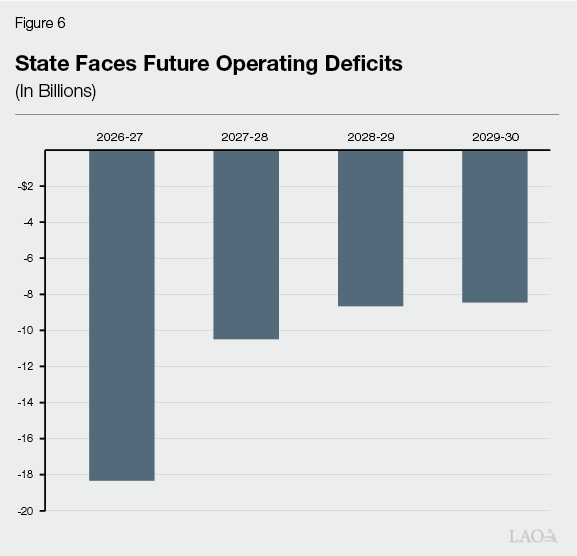
Administration Projects Operating Deficits Throughout the Forecast Period. Once the entering fund balance is spent down, the state no longer has a comparable cushion to draw on, and the operating deficit becomes a closer approximation of the budget’s year‑to‑year condition. Under the administration’s estimates and proposals, the operating deficit narrows after 2026‑27—to $10.4 billion in 2027‑28, $8.7 billion in 2028‑29, and $8.3 billion in 2029‑30—but remains notable throughout the forecast period.
State Appropriations Limit
Under Proposition 4 (1979), the Constitution limits how the state can spend revenues that exceed a certain limit—a set of formulas known as the SAL. During the revenue surges in the early 2020s, the SAL was an important constraint in the budget process and had significant implications for the Legislature’s budget decisions. For the last few years, however, the SAL has not been salient to the budget process. This is because declines in revenues, coupled with some growth in the limit, have meant the state has more room.
Figure 7 provides an overview of the SAL estimates in this year’s budget. As the figure shows, under the budget package, the state has $27 billion in room under the SAL limit in 2026‑27—an increase from $8 billion in room in 2025‑26. Because appropriations subject to the limit remain below the constitutional limit, the state does not have excess revenues in 2026‑27, meaning no additional funding for schools or taxpayer rebates is triggered under Article XIII B. As noted above, if passed by voters, Proposition 2 (2026) would change how BSA and TSHA transfers are treated under the SAL beginning in 2027‑28.
Figure 7
State Appropriations Limit (SAL) Estimates
(In Billions)
|
2024‑25 |
2025‑26 |
2026‑27 |
|
|
SAL Revenues and Transfers |
$263.4 |
$281.1 |
$280.3 |
|
Exclusions |
‑120.3 |
‑122.5 |
‑125.6 |
|
Appropriations Subject to the Limit |
$143.1 |
$158.6 |
$154.7 |
|
Limit |
$147.6 |
$166.9 |
$182.0 |
|
Room/Negative Room |
$4.5 |
$8.3 |
$27.3 |
|
Excess Revenues? |
No |
||
|
Note: Reflects administration estimates of budget actions taken through July 1, 2026. |
|||
Evolution of the Budget
This section provides an overview of the 2026‑27 budget process. Figure 8 contains a list of the budget‑related legislation passed on or before July 1, 2026.
Figure 8
Budget‑Related Legislation Passed On or Before July 1, 2026
|
Bill Number |
Chapter |
Subject |
|
Budget Bills and Amendments |
||
|
AB 109 |
19 |
2026‑27 Budget Act |
|
AB 112 |
22 |
Amendments to the 2022‑23, 2023‑24, 2024‑25, and 2025‑26 Budget Acts |
|
SB 111 |
21 |
Amendments to 2026‑27 Budget Act |
|
Trailer Bills |
||
|
AB 126 |
65 |
Education |
|
AB 150 |
25 |
Early care and education |
|
AB 152 |
26 |
Human services |
|
SB 125 |
24 |
Medi‑Cal: Managed care organization provider tax |
|
SB 135 |
79 |
Higher education |
|
SB 163 |
80 |
Developmental services |
|
SB 164 |
27 |
Health |
|
SB 165 |
61 |
Skilled nursing facilities: reimbursement rates |
|
SB 166 |
62 |
Public resources |
|
SB 168 |
81 |
Public resources |
|
SB 169 |
82 |
Transportation |
|
SB 170 |
28 |
Governor’s reorganization plan |
|
SB 171 |
83 |
Labor |
|
SB 172 |
84 |
State government |
|
SB 174 |
29 |
Courts |
|
SB 177 |
64 |
Medi‑Cal: Fair Share for Big Corporations Act |
|
SB 179 |
68 |
Housing |
|
SB 180 |
85 |
Taxes |
|
Note: This figure includes budget bills and trailer bills identified in Section 39.00 in the 2025‑26 Budget Act that were passed by the Legislature on or before July 1, 2026. Ordered by bill number. |
||
Governor’s January Budget Proposal
Governor’s Budget Roughly Balanced on Higher Revenues. Governor Newsom’s administration presented its proposed state budget to the Legislature on January 9, 2026. At the time, the administration estimated the budget faced a roughly $3 billion deficit—which we characterized as roughly balanced. This was considerably smaller than the $18 billion deficit we had projected in our November Fiscal Outlook. The difference was driven almost entirely by the administration’s higher revenue estimate, a $42 billion upgrade from the 2025‑26 Budget Act reflecting strong income tax collections tied to a stock market boom.
Governor’s Budget Solutions Relied on Borrowing and New Reserve Use. The Governor’s budget included about $9 billion in budget solutions, the two largest of which were a $5.6 billion Proposition 98 settle‑up obligation (funding schools and community colleges below the estimated constitutional minimum for 2025‑26) and the suspension of a $2.8 billion BSA true‑up deposit otherwise required for 2025‑26. The budget also proposed setting the state’s operating reserve, the SFEU, at $4.5 billion, and included about $600 million in new discretionary spending.
Spring Revenue Collections
February Collections Confirmed Continued Revenue Strength. In February, we published an updated revenue forecast finding that income tax collections in December and January had exceeded Governor’s budget projections by about $6 billion, driven by continued stock market gains connected to investor enthusiasm around artificial intelligence. We estimated this improvement translated into a roughly $2.5 billion upgrade to the budget’s bottom line relative to January. At the same time, we reiterated that similar asset‑price‑driven revenue surges in 2000, 2006, and 2021 were each followed by sharp reversals, and recommended that the Legislature treat any additional resources at the May Revision as a one‑time windfall—to be used to reduce reliance on reserves and budgetary borrowing rather than to fund new ongoing commitments.
Governor’s May Revision
Higher Revenues Again Improved the Budget’s Bottom Line. Governor Newsom presented the May Revision on May 14, 2026. Relative to the January budget, the administration’s revenue estimates across the three‑year budget window (2024‑25 through 2026‑27) increased by about $16 billion, again reflecting continued strength in income tax collections. Higher constitutionally required spending on schools, community colleges, and reserves partially offset this improvement. The May Revision also reflected operating deficits that were about half as large as those in the January budget proposal—reducing these deficits was consistent with our guidance.
May Revision Continued to Rely on Reserves and Borrowing. The May Revision continued to rely on reserves and borrowing to balance the budget. The May Revision also introduced a first‑time proposal to deposit nearly $10 billion into the TSHA—a mechanism created in 2024 to guard against overcommitting uncertain revenue—and withdraw the same amount in 2027‑28, in effect using anticipated 2026‑27 resources to help balance the following year’s budget. Separately, the administration proposed a smaller $4 billion Proposition 98 settle‑up obligation (down from $5.6 billion in January), which added to the state’s outstanding budgetary borrowing, projected to approach $30 billion.
Proposed New Ongoing Revenues and Other Solutions. The Governor also proposed ongoing revenue solutions: a renewed and larger MCO tax (providing roughly $575 million in General Fund savings in 2026‑27, growing to about $2 billion annually), a permanent cap on business tax credits (an estimated $850 million in 2026‑27), and extending the sales tax to certain digital software sales (an estimated $450 million in General Fund revenue in 2026‑27). Combined with expanded Medi‑Cal spending reductions and fund shifts, the May Revision’s solutions totaled about $14 billion.
Legislature’s Budget
In the weeks following the May Revision, the Assembly and Senate each held hearings on and adopted their own versions of the budget. The two houses reconciled their differences into a joint legislative budget, passed on June 15, 2026. This version adopted the May Revision’s proposed $5 billion package of ongoing revenue solutions (the MCO tax, the software sales tax, and the business tax credit cap) and included $15.1 billion in the BSA. Relative to the May Revision, the Legislature’s budget assumed $5 billion more in revenues in 2025‑26. The budget then used this new capacity to reject or delay many of the Governor’s proposed Medi‑Cal reductions; restore funding for child care slot expansion; and increase funding for HHAP, affordable housing, and immigration legal aid. The Legislature’s budget also proposed placing reforms to the BSA on the November 2026 ballot.
Final Budget Package
The Legislature and the Governor reached a final agreement in late June, and the Legislature passed the amended budget act and associated trailer bills on June 29, 2026. The next section of this report describes the major features of the final budget package.
Major Features
Tax Policy
Extends Limitations on Business Tax Credits. Two years ago, the state temporarily increased corporation tax revenues by limiting the amount of tax credits a business can claim to $5 million for tax years 2024, 2025, and 2026. A new mechanism also was created for taxpayers to recoup these temporary tax increases as tax refunds in future years. The budget extends this limitation through 2029. Beginning in 2030, the budget also permanently limits business tax credit claims to the greater of $5 million or 70 percent of the business’ tax liability. The administration estimates that the extension of the limitation raises General Fund revenue by $1 billion in 2026‑27, $3.3 billion in 2027‑28, and over $4 billion per year for the remainder of the budget multiyear.
Renews Enrollment Tax on Health Plans. The health plan tax (also known as the MCO tax) is a specific tax on health plan enrollment that helps pay for Medi‑Cal. The current tax, set to expire at the end of 2026, provides the state around $7 billion to $8 billion in net revenue annually. This year’s spending plan assumes federal approval of a renewed tax from January 2027 through the end of 2029. The renewed tax is estimated to provide $2.3 billion in net revenue, a much smaller amount compared to the current tax. Though smaller in size, the renewed tax will be much costlier to health plans (and likely their consumers). This is because the current tax derives nearly all of its revenue from plans’ Medi‑Cal enrollment, which effectively is paid for by the federal government. The renewed tax, by contrast, will derive around two‑thirds of its net funding ($1.5 billion) from plans’ private enrollment. This structural change is needed to comply with new federal rules around provider taxes in Medicaid.
Applies Sales Tax to Digital Prewritten Software. Starting January 1, 2027, the budget extends the sales tax to many sales of prewritten software. The administration estimates that this would raise General Fund revenue by $450 million and local sales tax revenue by $560 million in 2026‑27, when it would be in effect for half a year. The full‑year revenue estimates for 2027‑28 and ongoing are $900 million General Fund and $1.1 billion in local sales tax revenues.
K‑14 Education
Unlike the Rest of the Budget, Substantial Resources Available for New K‑14 Education Spending. Proposition 98 creates a “budget within a budget” by establishing a minimum funding level for schools and community colleges that is calculated using a set of constitutional formulas. The state meets the guarantee through a combination of General Fund and local property tax revenue. From the minimum annual funding level determined by Proposition 98, the Legislature decides how to allocate resources among various K‑14 programs, including funding for existing programs. Although growth in the minimum funding level for K‑14 education has a direct relationship with General Fund revenues, the condition of the Proposition 98 budget can differ substantially from the condition of the rest of the budget. Compared with the June 2025 estimates, the guarantee is up $29 billion across the budget window. This increase mainly reflects higher General Fund revenue estimates. After accounting for the cost of current law and policy commitments—including constitutionally required Proposition 98 Reserve deposits and statutory COLA—about $17 billion is available for new discretionary spending. (This estimate does not include the cost of resolving the settle‑up obligation described earlier in this report, which would require additional funding in a future year.)
Provides Ongoing Funding Increases Beyond the Statutory COLA. The budget increases per‑student funding rates under the K‑12 Local Control Funding Formula and community college Student Centered Funding Formula by 4.31 percent. Of this increase, 2.87 percent is to cover the statutory COLA and 1.44 percent is a discretionary augmentation. Part of the discretionary increase funds a new requirement for paid pregnancy disability leave. Specifically, trailer legislation requires all school and community college employers to offer up to 14 weeks of leave at full pay for any employee (excluding a substitute) who experiences a disability resulting from pregnancy, childbirth, or miscarriage, beginning in 2026‑27.
Funds Several Other Ongoing Increases. For schools, the budget provides $2.4 billion to bring the statewide funding rate for special education to $1,340 per student, an increase of $396 per student (42 percent) beyond the COLA‑adjusted level. The budget also provides $1 billion for a new ongoing community schools program. This augmentation will provide ongoing support for previous grant recipients and expand the community schools model to additional low‑income schools. For community colleges, the budget provides $153 million for an additional 2.5 percent enrollment growth across 2025‑26 and 2026‑27, as well as $48 million to allow districts to claim the higher of their three‑year average or current level of credit enrollment.
Funds Discretionary Grants and a Few Other Notable One‑Time Activities. For schools, the budget provides $5 billion for the Student Support and Professional Development Discretionary Block Grant. Districts may use these funds for any local purpose, but trailer legislation encourages them to prioritize professional development, teacher retention and recruitment, community schools, career education, and deferred maintenance. The state will distribute funds on an equal per‑student basis (estimated at $932 per student). The budget also provides notable funding for learning recovery, literacy coaches, teacher training and recruitment, and kitchen infrastructure. For community colleges, the budget provides $147 million for the Student Support Block Grant. Districts may use these funds for a range of student services, including basic needs (such as food, housing, and transportation), financial aid, counseling, and job placement activities. The state will allocate funds based on student headcount and the share of students qualifying for fee waivers or nonresident tuition exemptions, with a minimum grant of $150,000 per college in each district. The budget also provides notable funding for deferred maintenance as well as various other student support and workforce development initiatives.
H.R. 1‑Related Actions
Implements Recently Enacted Federal H.R. 1 Legislation. In July 2025, Congress enacted H.R. 1, which makes substantial changes to federal Medicaid and food assistance policies and funding. This year’s spending plan reflects these changes and implements several of them in trailer bill legislation. The Legislature also took additional actions in response to H.R. 1, described below. In all, these changes and actions are estimated to cost the state $1.7 billion General Fund in 2026‑27. As of June 2026, the administration also estimates total disenrollments of 1.3 million from Medi‑Cal and 700,000 from CalFresh through 2029‑30.
Restricts Eligibility for People With UIS. People with UIS (mostly undocumented immigrants, but others too) do not qualify for most federally funded health coverage. The state, however, has provided these people with comprehensive coverage funded solely by the state. The spending plan takes two key actions affecting this population. First, the spending plan applies work requirements and other H.R. 1 eligibility rules to them. Second, it ends comprehensive coverage for immigrant groups that become newly UIS under H.R. 1 (such as refugees and asylees). Neither action is required under H.R. 1, though they result in savings and avoid backfilling lost federal funding. The actions begin in 2027, with the associated General Fund savings ramping up over time (we estimate from around $60 million in 2026‑27 to around $3 billion in 2029‑30).
Supports County and State Implementation of New Eligibility Rules. On the other hand, the spending plan also adds new spending to implement H.R. 1’s requirements, particularly related to new requirements to maintain enrollment. Most notably, it provides one‑time General Fund augmentations to support county eligibility determination work in Medi‑Cal and CalFresh through H.R. 1 implementation, including $197 million ($709 million total funds) for Medi‑Cal and $223 million ($460 million total funds) for CalFresh. These one‑time allocations are intended to support county implementation efforts over multiple years. The spending plan also includes some additional resources for the Departments of Health Care Services and Social Services to implement H.R. 1 provisions.
Partially Backfills Lost Federal Funds and Provides Some Limited, Targeted Assistance. The spending plan also backfills some of the lost federal funding resulting from H.R. 1, resulting in additional required state costs. Most notably, it backfills reductions in federal matches for emergency Medi‑Cal coverage and for CalFresh administration, with ongoing costs at around $1 billion General Fund. Additionally, while the spending plan does not backfill lost Medi‑Cal and food benefits, it targets some one‑time funds to certain entities and providers. For example, the spending plan provides $108 million General Fund in 2026‑27 ($100 million above typical ongoing state support) to support food banks that are expected to experience higher demand due to CalFresh disenrollment. It also provides $90 million General Fund in 2025‑26 to support family planning providers that temporarily lost federal assistance under H.R. 1.
Higher Education
Provides Universities With Large Base Increases. The 2026‑27 budget package includes a $1.2 billion ongoing General Fund augmentation for the University of California (UC) and California State University (CSU) combined. Consistent with the 2025‑26 budget agreement, UC and CSU each receive a 7 percent base increase along with a 3 percent base restoration relating to payment deferrals enacted last year. Though the base increases are largely unrestricted, UC and CSU are to use them in part to cover enrollment growth costs. The 2026‑27 Budget Act sets forth resident undergraduate enrollment growth targets of 1.4 percent at UC and 1 percent at CSU. Beyond these base increases, UC receives $61 million to complete implementation of the nonresident enrollment replacement plan and CSU receives $91 million for health care and certain pension cost increases. In addition, the 2026‑27 budget package contains one‑time General Fund totaling $152 million for 25 UC initiatives and $6 million for 2 CSU initiatives.
Makes Large Out‑Year Funding Commitments for the Universities. Also consistent with the 2025‑26 budget agreement, the state maintains three out‑year funding commitments for UC and CSU totaling $1.1 billion (nearly $800 million in 2027‑28 and $300 million in 2028‑29). All of these commitments are in response to the state providing less than intended for the universities in 2025‑26. Notably, the state plans to provide UC and CSU a combined $524 million one‑time General Fund back payment in 2027‑28 in response to not providing a compact base increase in 2025‑26. The state also plans to provide $274 million one‑time General Fund in 2027‑28 to retire UC and CSU payment deferrals instituted in 2025‑26. In 2028‑29, the state further plans to provide UC and CSU a combined $296 million ongoing General Fund augmentation, reflecting a 3 percent base increase associated with the remaining postponed 2025‑26 compact payment.
Includes Some Notable Financial Aid Actions. The 2026‑27 Budget Act includes a $301 million ongoing augmentation for the Cal Grant Program, part of which covers the cost of higher UC and CSU tuition awards. The state makes one temporary Cal Grant policy change—raising the Transfer Entitlement age cap from age 28 to 30 for five years (2027‑28 through 2031‑32). Provisional language indicates the state’s intent to provide a total of $111 million to cover the cost associated with this policy change. The budget includes $959 million to cover the cost of Middle Class Scholarships (MCS) in the 2025‑26 award cycle (as the program is being paid in arrears). For the 2026‑27 award cycle, the state reduces coverage from 35 percent to 23 percent of students’ remaining need. MCS costs are expected to decline an estimated $268 million in 2027‑28 as a result of this change. The budget also extends the Golden State Teacher Grant program (for students in teacher credential programs) and includes a small amount of one‑time funding for the state to undertake certain administrative tasks to begin implementing the new federal Workforce Pell Grant program, which took effect on July 1, 2026.
Housing and Homelessness
Adopts Policies Aimed at Streamlining the State’s Affordable Housing Funding System. In recent years, the Legislature and Governor have been attempting to create a more coordinated funding system for affordable housing. Most notably, these efforts included a reorganization approved last year which is intended to create within the administration a “one‑stop shop” called the Housing Development and Finance Committee (HDFC). (For more information on last year’s reorganization, please see our report, The 2025‑26 California Spending Plan: Housing, Homelessness, and Local Government.) As a next step in this streamlining process, the 2026‑27 budget package creates a special set aside for HDFC‑awarded housing projects, such that they will automatically receive federal tax credits (rather than having to compete with other project proposals for the tax credits—a key funding source for virtually all affordable housing projects). In addition, the budget agreement splits the Affordable Housing and Sustainable Communities program, which has been administered by the Strategic Growth Council as an integrated housing‑transportation award, and places the affordable housing component with HDFC.
Provides Funding for Affordable Housing. In addition to these streamlining efforts, the 2026‑27 budget provides some funding for affordable housing programs. This includes $200 million one‑time General Fund for the Multifamily Housing Program, the state’s flagship affordable housing program. The budget also authorizes $500 million for the state Low‑Income Housing Tax Credit program. (This amount is in addition to about $135 million in statutorily required state tax credits for the program in 2026‑27.) Due to changes affecting the Greenhouse Gas Reduction Fund (GGRF), however, the budget package assumes a much lower level of ongoing funding for the Affordable Housing and Sustainable Communities program than what has been provided in prior years. (For an overview of these changes to GGRF, please see the “Other” section.) Finally, in June 2026, the Legislature placed a housing bond on the November 2026 ballot (Proposition 1), which, if approved by voters, would provide billions of dollars for various state affordable housing programs.
Adds Funding and Requirements for State’s Main Homelessness Program. Last year’s budget appropriated $500 million one‑time General Fund for a seventh round of the HHAP program in 2026‑27. This funding was made contingent on subsequent enactment of legislation that enhances accountability for the program. The 2026‑27 budget adds $400 million one‑time General Fund to HHAP, bringing total funding for the seventh round to $900 million. In an effort to increase accountability, the budget package also includes several new statutory requirements for grantees. This includes a local matching requirement for all cities (and the counties in which those cities are located) receiving seventh‑round HHAP funding.
Labor and Employment
Allocates $668 Million for Interest Payment on Federal Unemployment Insurance (UI) Loan. The budget agreement includes $668 million General Fund to make the required annual interest payment on the state’s outstanding federal UI loan. As of July 2026, the state’s outstanding federal loan was $18.5 billion, approximately the same amount as was originally borrowed during the pandemic. The interest rate on the outstanding loan is variable and for this year was 3.2 percent.
Tightens Eligibility for Workers’ Compensation Benefits for Workers With Pre‑Existing Disabilities. A budget trailer bill—Chapter 83 of 2026 (SB 171, Committee on Budget)—tightens eligibility for the Workers’ Compensation Subsequent Injury Benefit Trust Fund program, which pays lifetime disability benefits to injured workers with pre‑existing health conditions. The new rules apply to pending claims filed after July 1, 2020. The budget plan also funds implementation. (For more information on this program, see our report, Refocusing the Worker’s Compensation Subsequent Injury Program.)
Other
Allocates Most GGRF Monies, Defers Some Related Decisions. The June budget package assumes about $3.1 billion in spending from GGRF, largely allocated pursuant to the tiered framework established by Chapter 121 of 2025 (SB 840, Limón). This includes:
- Tier 1. Provides roughly $350 million for various existing statutory activities including state operations support and backfilling revenue losses from both the suspended State Responsibility Area fee and a manufacturing tax exemption.
- Tier 2 and Other Discretionary. Provides a total of $2.4 billion for three categories of activities: $1.25 billion to support operations at the California Department of Forestry and Fire Protection (achieving a like amount of General Fund savings, consistent with a prior‑year budget agreement); $1 billion for the high‑speed rail project, as required by SB 840; and $115 million for a new zero‑emission vehicle (ZEV) purchase incentive program.
- Tier 3. Plans for an estimated total of $372 million for programs that receive statutory continuous appropriations, including for local transit, safe drinking water, and forest health projects. (The actual amount of funding that Tier 3 programs receive will depend on how much revenue the state receives from cap‑and‑invest program auctions over the coming year.)
The budget package also includes some supplemental funding from other sources for programs that have historically been funded by GGRF, including $150 million from the General Fund for the Community Air Protection Program established by Chapter 136 of 2017 (AB 617, Garcia) and $173 million from other special funds for various ZEV purchase incentives. The budget package defers action on some GGRF‑related proposals to later in the summer, including (1) a trailer bill that would make various changes to SB 840; (2) $250 million for Tier 2 legislative priorities identified in SB 840; (3) funding support for certain new state operations activities; and (4) statutory language to establish a new Legislative Climate Bureau, consistent with intent language included in SB 840. (Please see our post, The 2026-27 California Spending Plan: Natural Resources and Environmental Protection, for an updated summary of GGRF-related spending including August budget actions.)
Expands and Delays Some Previously Enacted Medi‑Cal Budget Solutions. The spending plan revises several ongoing Medi‑Cal budget solutions enacted last year. Some revisions expand them, resulting in more savings. Most notably, this year’s health trailer bill legislation reduces the reinstated asset limit for seniors and persons with disabilities beginning July 2027. The administration estimates this change saves $257 million ongoing General Fund. On the other hand, other revisions delay the start of enacted budget solutions by 12 months. These delays cost the state $1.6 billion one‑time General Fund in 2026‑27.
Provides Additional Support for Hospitals. California pays billions of dollars each year to its hospitals, primarily as reimbursement for services provided to Medi‑Cal patients. Recent budgets have provided additional one‑time loans to support financially distressed hospitals. This year’s spending plan builds upon these past initiatives by providing $365 million one‑time General Fund to hospitals. Most of this amount ($250 million) is for grants to UC and county hospitals. The remainder ($25 million in 2025‑26 and $90 million in 2026‑27) is for grants to private nonprofit and public hospitals that are financially distressed.
Provides Court Facility and New Judgeship Funding. The budget provides $2.1 billion in 2026‑27 (declining annually to $44 million by 2028‑29 and ongoing) from various fund sources to support courthouse construction, facility modification, and deferred maintenance projects, as well as new judgeships. This includes:
- $1.7 billion one‑time lease revenue bond authority for the design‑build and construction phases of nine courthouse construction projects.
- $150 million one‑time General Fund for deferred maintenance projects.
- $102 million in 2026‑27 declining to $38.5 million in 2027‑28 largely from the General Fund for various phases of 11 court construction projects and one facility modification project.
- $100 million General Fund in 2026‑27 declining to $44 million in 2027‑28 and ongoing to support 13 new judgeships and the facility modification projects to accommodate them.