Ann Hollingshead

November 18, 2026
The 2027-28 Budget
California’s Fiscal Outlook
- Executive Summary
- Introduction
- Stock Market Risk Looms Over Budget
- Understanding the Budget Condition Under Our Forecast
- Conclusion
- Appendix 1
- Appendix 2
Executive Summary
Stock Market Poses a Serious Risk to Revenues. Since 2023, the state budget has been the beneficiary of an extended stock market boom. Even now this boom appears to be resulting in continued strength in income tax collections. That said, while the stock market’s recent run has been great for many investors and the state budget, it now appears to have advanced to a dangerous stage. The risk now facing state revenues is that this boom, like many in the past, will abruptly end in a bust.
This Fiscal Outlook Meaningfully Incorporates This Risk. The state must decide how much revenue it can depend on having to pay for current services to Californians who rely on them. We view building a state budget around revenues that do not incorporate the meaningful danger of a market downturn as unduly risky. As such, our Fiscal Outlook explicitly incorporates this risk in two ways. First, to offer some insurance against a stock market downturn, our revenue forecast is somewhat weaker than suggested by recent collection trends, but still well above where it would be if a market crash occurred. This is the forecast we recommend policymakers use as a starting point to reduce the likelihood the state makes commitments it will be unable to afford in the future. Second, to gauge the state’s preparedness for a stock market downturn, we present an estimate of the state’s budget condition under a scenario where the stock market peaks at the end of this year and crashes over the course of 2027.
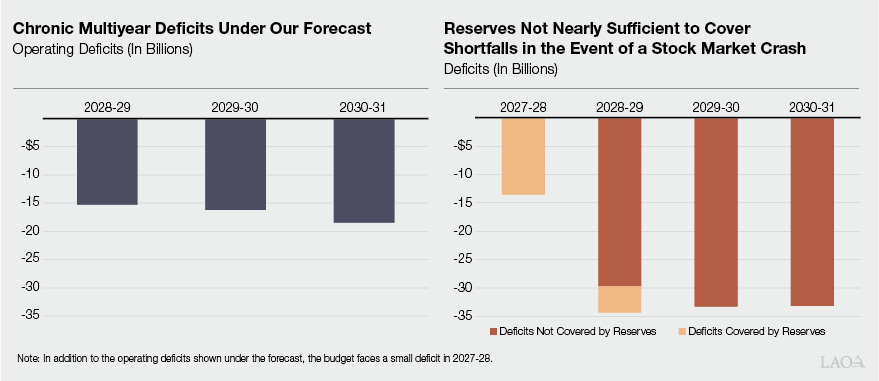
Under Our Forecast, Existing Commitments Exceed Revenues. Under our forecast, there is a small deficit of $2 billion at the end of 2027‑28. Starting in 2028‑29, however, deficits would be considerably larger, as shown on the left side of the figure. Although these out‑year deficits have narrowed from the ones we projected a year ago—mainly due to the artificial intelligence (AI)‑driven stock market surge and ongoing reductions enacted in this year’s budget—deficits persist because the underlying imbalance has not been fully resolved.
Reserves Not Nearly Sufficient to Cover Shortfalls in the Event of a Stock Market Crash. If the current AI boom is a speculative bubble that ends in a bust, there will be severe budget shortfalls. As the right side of the figure shows, under this scenario, annual deficits would exceed $30 billion. If something like this scenario occurs, the state’s reserves and borrowing capacity will be insufficient, almost certainly necessitating sizeable ongoing cuts or revenue increases within a couple of years.
Recommendations. We recommend the Legislature use our Fiscal Outlook revenue forecast as a starting point for the budget, which provides a reasonable level of insurance against a market downturn. If tax collections continue to beat expectations, we strongly recommend using any resulting resources to rebuild the state’s budget resilience, either by making extra deposits into reserves or by repaying outstanding budgetary debts. Given the sizeable structural deficits under our forecast, and the clear and present risk of a stock market crash, we recommend the Legislature adopt ongoing solutions that fully address the 2027‑28 budget problem. We also recommend the Legislature begin identifying additional ongoing solutions now, either to address the larger deficits projected for 2028‑29 or to prepare for a potential market downturn.
Introduction
Each year, our office publishes the Fiscal Outlook in anticipation of the upcoming budget season. This report provides the Legislature our independent estimates of the state’s economy, revenues, and spending, along with our assessment of the General Fund condition for 2027‑28 through 2030‑31.
Since 2020, California’s budget situation has been turbulent. Over the last six years, the budget has swung from a significant pandemic‑era budget deficit that never materialized, to record‑breaking surpluses, to large and persistent deficits, to an artificial intelligence (AI) boom that masked—but didn’t resolve—an underlying structural deficit. In this publication, we examine where the budget stands as this AI boom appears to be losing steam. We find that, for the fifth year in a row, California faces deficits.
We first outline the risks the stock market poses to the budget picture and provide our recommendations for how the Legislature can use this information for budgetary planning. Then, we discuss some of the technical budget changes and dynamics important to understanding the more detailed budget picture.
Stock Market Risk Looms Over Budget
This section presents our overall assessment of revenues and the budget condition, explains why the stock market poses a significant risk to both, and offers our recommendations for how the Legislature can plan for that risk.
Why Is the Stock Market a Risk to Revenues?
Stock Market Boom Has Boosted State Tax Collections for Three Years. Since 2023, the state budget has been the beneficiary of an extended stock market boom. After bottoming out in late 2022, technology stocks in the Nasdaq‑100 index have grown more than 150 percent, while the broader S&P 500 index has doubled. State income tax collections, which rely heavily on income tax payments tied to the stock market, similarly grew at double the historical norm over the last three fiscal years, driven by investment gains and stock pay among high‑income taxpayers. Income tax collections have grown a bit slower so far this fiscal year but continue to outpace budget projections.
Boom Appears to Be a Speculative Bubble. While the stock market’s recent run has been great for many investors and the state budget, it now appears to have advanced to a dangerous stage. The recent market run‑up shares several common characteristics with past speculative bubbles that eventually ended with crashes. A technological or societal development causes an economic shock that creates large early investment gains. Chasing these gains, a growing number of investors buy stocks in companies linked to the economic shock, driving stock prices up further. Eventually, this enthusiasm builds into a euphoria in which investors go all in on stocks, often taking on large amounts of debt to do so. Stock prices rise so high they become divorced from underlying fundamentals, like company profits. All of these hallmarks are present in today’s AI‑driven enthusiasm:
- U.S. households have dramatically increased their ownership of stocks over the last four years, pushing their stock holdings to 175 percent above historical norms.
- Debt taken on by investors to buy stocks has more than doubled over the last three years.
- Relative to measures of past and current corporate profits, stock prices are at historic highs rivaled only by the dot‑com boom.
Booms Often End in a Bust, and This Boom May Be Running Out of Steam. The risk now facing state revenues is that this boom, like many in the past, will abruptly end in a bust. In our Fiscal Outlook last November, we highlighted many of these same patterns, suggesting the stock market was overheated and could be heading for a downturn in the next couple of years. Since then, all these signals have intensified, but no bust has occurred. It may be tempting to conclude this means these signals are wrong this time. But we caution that the opposite could be true: the risk of a market reversal is even greater now. In fact, the market has moved sideways since June, suggesting that, with investors seemingly all in already, paths for continued expansion could be narrowing. On top of this, financing for AI might be tightening, in part because the Federal Reserve might need to further rein in financial conditions to address stubborn inflation. Risks are likely to remain high until the warning signs we have highlighted return to more normal levels.
Too Risky for the State to Assume This Time Is Different. Counterarguments could be offered. AI could be a uniquely special technology that results in more rapid productivity growth than past technologies. The federal government could be inclined to step in and support the market due to the economic importance of technology companies. The transformative nature of AI could mean traditional ways of valuing stocks are outdated. Perhaps these arguments will prove correct. Assuming this best‑case scenario, however, is very risky for the state when its revenues are so exposed to near‑term changes in the market. While a long‑term investor may be able to look beyond the shorter‑term risk of a bubble to the future potential of AI, the state is in a different position. The state must decide how much revenue it can depend on having to pay for current services to Californians who rely on them. As such, building a state budget around revenues that do not incorporate the meaningful danger of a market downturn is unduly risky.
What Does This Risk Mean for the Budget?
Two Ways to Think About the Budget Condition Given Stock Market Risk. Our Fiscal Outlook is built around the premise that stock market risk must be meaningfully incorporated into any assessment of the state’s budget condition. We offer two approaches to help state leaders consider these risks:
- Revenue Forecast That Offers Some Insurance Against a Stock Market Downturn. Consistent with continued strength in income tax collections, as well as recently improved trends in sales and corporate taxes, our Fiscal Outlook revenue forecast includes an upgrade of almost $15 billion over the 2026‑27 Budget Act for the current year. Moving forward, our forecast, reflecting the risk presented by the stock market, assumes this upgrade in income taxes will reverse beginning in 2027‑28. We do not assume a stock market downturn is certain. Instead, our forecast is somewhat weaker than suggested by collection trends, but still well above where it would be if the stock market actually crashed. This middle‑ground approach offers two advantages. First, the approach offers the state some insurance against revenue declines, resulting in smaller budget corrections should a crash occur. Second, by taking a portion of the potentially unsustainable revenues “off the table,” this approach makes it less likely the state makes commitments it will be unable to afford in the future. As such, a budget plan built around our revenue forecast will have a better chance of being sustainable moving forward than a plan that insufficiently accounts for stock market risk.
- Stock Market Crash Scenario to Evaluate Preparedness. While we recommend our revenue forecast as a starting point for budget planning, we also think it is important for state leaders to consider how a full‑scale stock market crash would affect the state’s budget condition. Assessing how prepared the state budget is for a stock market crash helps inform present decisions about the need to build reserves, pay down debts, or improve budget resilience in other ways. Toward this end, we present an estimate of the state’s budget condition under a scenario where the stock market peaks at the end of this year and crashes over the course of 2027.
Under Our Forecast, Existing Commitments Exceed Revenues. Under our forecast, there is a small deficit of $2 billion at the end of 2027‑28. This means that, for the fifth year in a row, budget solutions are likely required during the upcoming budget process. Starting in 2028‑29, deficits would be considerably larger. Figure 1 shows the budget’s multiyear position under our revenue forecast. Existing commitments would exceed revenues, resulting in future annual deficits exceeding $15 billion. (Although the state would have reserves available, we would not advise using this one‑time tool to address what otherwise appears to be an ongoing shortfall.)
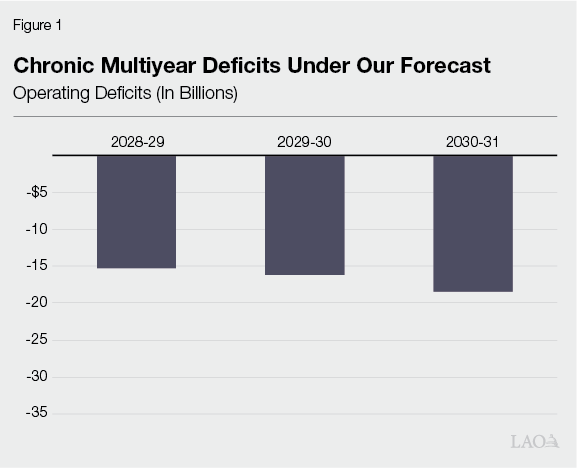
Revenue Surge Has Narrowed, Not Closed, the Structural Gap. These out‑year deficits are much smaller than the ones we projected in last year’s Fiscal Outlook. This improvement is mainly the result of the AI‑driven stock market boom and ensuing revenue surge, but also due to ongoing budget solutions adopted in the 2026‑27 budget process (which were largely focused on Medi‑Cal). Deficits persist, however, because the underlying imbalance has not been fully resolved. (We describe these dynamics in more detail in our recent post, From Pandemic to AI Boom: The State Budget Since 2020.)
Reserves Not Nearly Sufficient to Cover Shortfalls in the Event of a Stock Market Crash. If the current AI boom is a speculative bubble that ends in a bust, there will be severe budget shortfalls. Figure 2 shows the budget condition under our crash scenario, in which the stock market peaks at the end of 2026 and declines sharply over the course of 2027. Under this scenario, over the entire period, revenues would fall by over $130 billion below our forecast and annual deficits would exceed $30 billion. (These estimates account for reductions in constitutional requirements under Proposition 98 [1988] and Proposition 2 [2026] that result from lower revenues. They do not reflect other cost increases that could accompany a broader economic slowdown, which could make deficits larger.) The state’s reserves would cover only a fraction of these shortfalls.
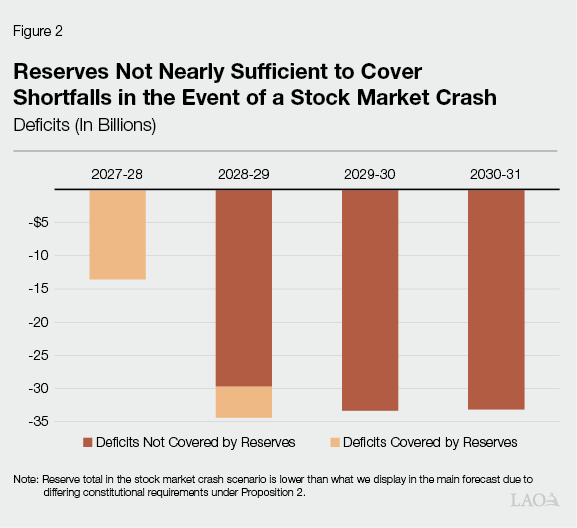
Budget Resilience Has Already Been Depleted. In some ways, the deficits shown in Figure 2 understate the challenge. When revenues fell a few years ago, the state initially closed budget gaps by pulling back billions of dollars in one‑time and temporary spending. Those reductions were not easy, but they were far less disruptive than cutting comparable amounts of ongoing spending. In subsequent years, the state used significant amounts of borrowing and reserve withdrawals to balance the budget. Today, the state has little one‑time spending left to pull back, reserves are still being rebuilt, and past borrowing has left an accumulated wall of debt of nearly $30 billion.
Crash Scenario Would Require Significant Actions Over Several Years. If the crash scenario occurs, the state’s remaining options will be few and difficult. Although some short‑term budget solutions would remain—such as additional borrowing, fund shifts, and deferrals—ongoing cuts and revenue increases would almost certainly be required within a couple of years. As an illustrative example, the state could achieve roughly $15 billion in ongoing solutions by either: (1) eliminating every discretionary service expansion that the state has enacted since 2019‑20 outside of K‑14 education, including remaining full‑scope Medi‑Cal coverage for individuals with unsatisfactory immigration status, child care slot expansions, university funding increases provided above inflation, and enhanced firefighting services; or (2) enacting another revenue increase package substantially larger than the recently approved Proposition 3 (2026). (See our recent report: Comparing Options to Raise and Lower Taxes for examples.)
What Does Revenue Risk Mean for Budget Planning?
Use Our Revenues as a Starting Point to Place Budget on More Sound Footing. As long as the stock market remains at its current elevated levels, tax collections over the coming months are likely to continue to beat expectations. As we move into the 2027‑28 budget process, this could create a temptation to disregard the continued risk of a stock market downturn and build a budget around more optimistic revenue assumptions. We caution that doing so would not be fiscally prudent. Instead, using our Fiscal Outlook revenues as a starting point for the budget would provide a reasonable level of insurance against a market downturn.
Save Any Near‑Term Revenue Improvements. If tax collections continue to beat expectations, we strongly recommend using any resulting resources to rebuild the state’s budget resilience, either by making extra deposits into reserves or by repaying outstanding budgetary debts. Further, if the Legislature elects to assume revenues more optimistic than our forecast, we similarly recommend using any new resources to rebuild budget resilience.
Prepare to Right‑Size the Budget. Although the budget problem in 2027‑28 is relatively small, it reflects a deeper imbalance between revenues and spending. Typically, the Legislature might address a small deficit with one‑time or temporary tools, such as borrowing or delaying planned program increases. Given the larger structural deficits under our forecast, and the clear and present risk of a stock market crash, we recommend a different approach. Specifically, we recommend the Legislature adopt ongoing solutions that fully address the budget problem in 2027‑28. We also recommend the Legislature begin identifying additional ongoing solutions now, either to address the larger deficits projected for 2028‑29 or to prepare for a potential revenue downturn. Developing these options now would help the Legislature be better prepared for the months and years ahead.
Understanding the Budget Condition Under Our Forecast
In this section, we provide more detail on the budget condition under our forecast. We begin by describing the state’s budget position in 2027‑28 and explaining why the budget has a small deficit, even though revenues have increased and the 2026‑27 Budget Act was designed to be balanced in 2027‑28. We then discuss key developments on the spending side of the budget, including an emphasis on the effects of Proposition 2 (2026) on reserve deposits and debt payments and our forecast of spending.
Small Deficit in 2027‑28. The budget has a small deficit in 2027‑28. Specifically, we estimate the balance of the Special Fund for Economic Uncertainties (SFEU), the state’s discretionary reserve, would be about negative $2 billion at the end of 2027‑28 (shown in Figure 3). To bring the SFEU to about $4 billion—around the level the Legislature has set in recent budgets—the state would need around $6 billion in budget solutions. (The State Constitution requires only that the budget be balanced, meaning a balance of zero or more, so the Legislature could choose a different SFEU level.)
Figure 3
General Fund Condition Under Fiscal Outlook
(In Millions)
|
2025‑26 |
2026‑27 |
2027‑28 |
|
|
Prior‑year balance |
$56,707 |
$59,409 |
$41,078 |
|
Revenues and transfers |
249,109 |
235,808 |
239,969 |
|
Expenditures |
246,408 |
254,139 |
255,083 |
|
Ending fund balance |
$59,409 |
$41,078 |
$25,964 |
|
Encumbrances |
$27,998 |
$27,998 |
$27,998 |
|
SFEU Balance |
$31,411 |
$13,080 |
‑$2,034 |
|
Reserves |
|||
|
BSA balance |
$11,496 |
$20,574 |
$25,566 |
|
SFEU = Special Fund for Economic Uncertainties and BSA = Budget Stabilization Account. |
|||
Budget Stabilization Account (BSA) Would Total Nearly $26 Billion by End of 2027‑28. Consistent with our view that the recent revenue surge was both temporary and driven by stock market gains, under our assumptions, Proposition 2 results in sizeable deposits across the budget window. The BSA more than doubles over the budget window—rising from about $11 billion in 2025‑26 to nearly $26 billion by the end of 2027‑28—representing about 11 percent of General Fund revenues and transfers.
What Has Changed Since June? When the Legislature enacted the budget in June, the starting place for 2027‑28 was balanced under the administration’s forecast. (Specifically, the budget assumed 2027‑28 would end with about $400 million in the SFEU. This balance was due in part to the Projected Surplus Temporary Holding Account, which shifts revenues from 2026‑27 to 2027‑28 to help cover a portion of the structural deficit in that year.) Under our forecast, the SFEU balance in 2027‑28 now is about negative $2 billion. As Figure 4 shows, this deterioration reflects four main changes across the budget window:
- Revenues Higher by About $11 Billion. Our forecast includes an improvement in 2026‑27, which is partially offset by lower revenues in 2027‑28. This reflects strong income tax collections and improved sales and corporate tax trends, combined with our assumption that the income tax upgrade reverses beginning in 2027‑28. Appendix 1 provides more detail on our revenue estimates under both our forecast and crash scenario.
- Proposition 2 Requirements Higher by About $9 Billion. Proposition 2 (2014) requires the state to make minimum annual deposits into the BSA and payments toward certain debts. In November, voters approved Proposition 2 (2026), which modified these rules. Due to both the new rules and higher estimates of capital gains revenues under our forecast, Proposition 2 requirements are about $9 billion higher across the budget window—offsetting most of the revenue upgrade.
- Proposition 98 General Fund Higher by About $4 Billion. Proposition 98 sets a minimum funding level for schools and community colleges (known as the minimum guarantee), met with a combination of General Fund and local property tax revenues. Our estimates of Proposition 98 General Fund costs are about $4 billion higher across the budget window due to higher revenues under our forecast.
- Other Spending Higher by $600 Million. Across the rest of the budget, our cost estimates are about $600 million higher than June 2026 budget estimates. This is mainly due to health and human services (HHS) programs. Although we project Medi‑Cal caseload to be about 4 percent lower than June 2026 estimates, which provides about $3 billion in savings, our projections of HHS costs overall are higher than the administration’s by nearly $4 billion in 2027‑28. (Our estimates assume H.R. 1 work requirements take effect on January 1, 2027 as scheduled. If the state were to use a newly announced federal flexibility to delay coverage losses under the requirements until July 2027, we estimate that Medi‑Cal costs could be about $700 million higher than our forecast across 2026‑27 and 2027‑28 combined.)
Figure 4
How the Budget Picture Has Changed
Since June
(In Billions)
|
Anticipated 2027‑28 SFEU at 2026‑27 Budget Act |
$0.4 |
|
Revenues higher |
$11.2 |
|
Proposition 2 requirements higher |
‑8.7 |
|
Proposition 98 higher |
‑4.2 |
|
Other spending changesa |
‑0.6 |
|
Anticipated SFEU at 2026 Fiscal Outlook |
‑$2.0 |
|
aIncludes a small amount of Proposition 2 debt. |
|
|
SFEU = Special Fund for Economic Uncertainties. |
|
Overall, Constitutional Requirements Take Up More Than Revenue Gain. Taken together, higher Proposition 2 and Proposition 98 requirements (about $13 billion) more than consume the roughly $11 billion revenue improvement in our forecast. This result is consistent with how the state’s constitutional formulas are designed. In particular, the revised rules under Proposition 2 require the state to set aside most of 150 percent of capital gains revenues above a specified threshold. As a result, when capital gains surge during a stock market run‑up, as they have recently, required reserve deposits and debt payments can grow by more than the associated revenue gains.
Debt Payments and Reserves
Existing Rules Under Proposition 2 (2014). Under Proposition 2 (2014), the state must set aside a portion of its revenues each year, split evenly between deposits into the BSA and payments toward certain debts. The set aside has two components: a base amount equal to 1.5 percent of General Fund revenues, and “excess capital gains,” meaning most capital gains revenues above 8 percent of General Fund taxes. Required deposits continue until their balance reaches 10 percent of General Fund taxes. Because these requirements depend on estimates of capital gains, which are nearly impossible to predict in advance, the state recalculates, or “trues up,” the BSA estimates for two subsequent years.
Proposition 2 (2026) Increases Debt Payments and Reserve Deposits. Proposition 2 (2026) makes two key changes that increase these requirements. First, for capital gains revenues above 10 percent of General Fund taxes, which we informally call “super excess capital gains,” the state must set aside most of 150 percent of the amount. (Capital gains between 8 percent and 10 percent of General Fund taxes are still set aside at most of the 100 percent level.) Second, the recently approved measure raised the maximum BSA balance from 10 percent to 20 percent of General Fund taxes.
BSA Requirements Higher by $7 Billion Relative to June 2026. Under our forecast, required BSA deposits across the budget window are $7 billion higher than June estimates. This is mainly because our forecast includes substantial capital gains revenues: $32 billion in 2026‑27 and $27 billion in 2027‑28—12.7 percent and 11.6 percent of General Fund taxes, respectively. Because capital gains exceed 10 percent of General Fund taxes in both years, the new 150 percent set‑aside applies. As a result, the state would make a new true‑up deposit of $5.5 billion for 2026‑27 and a deposit of $5 billion in 2027‑28, $1.6 billion more than the June estimate for 2027‑28.
Debt Payments Higher by Nearly $2 Billion. Unlike reserve deposits, debt payments are not trued up when revenue estimates change, so the increase in required debt payments under our forecast occurs solely in 2027‑28. Specifically, required debt payments in our forecast are nearly $2 billion higher than the administration’s June estimates. For purposes of this outlook, we assume the state continues to make payments toward its debts and liabilities under the current policy of Proposition 2. This includes: resuming prefunding of retiree health under the state’s policy and making scheduled General Fund repayments to retire an existing obligation related to pension prefunding. With the remaining funds, we assume the state pays down settle‑up associated with the 2025‑26 minimum guarantee. (In effect, the state would provide schools and community colleges the remaining funding they are owed for 2025‑26, repaying an obligation created as part of the 2026‑27 Budget Act.) This is an assumption, not necessarily a recommendation or a requirement. The state has several options for fulfilling its Proposition 2 debt payment requirement in 2027‑28, each with different trade‑offs. We describe these at a high level in the nearby box.
Proposition 2 (2026) Debt Payment Alternatives
What Is Eligible? Proposition 2 (2026) allows required debt payments to be used for a variety of new purposes. Under the new rules, eligible debts include: unfunded obligations to schools and community colleges (such as settle‑up), budgetary loans to the General Fund from other state accounts (such as special fund loans and certain loans from the state’s cash), unpaid mandate claims, unfunded liabilities of the state’s pension systems, prefunding of retiree health benefits, and the principal on the federal loan for the unemployment insurance (UI) program.
What Are the Trade‑Offs? Each of these options offers different benefits. For example, repaying special fund loans restores borrowing capacity the state could draw on in a future downturn. Making settle‑up payments benefits schools and community colleges. Paying unpaid mandate claims benefits local government budgets. Paying down unfunded pension and retiree health liabilities earlier than scheduled reduces state costs in the future (and by more than those repayments). Repaying the federal UI loan mitigates future payroll tax increases on California’s employers. Because the amount available for these payments is limited, choosing one option means giving up the benefits of others.
Program Spending
Spending Higher by $5 Billion Across the Budget Window. Across the budget window, our spending estimates are higher than the June figures by nearly $5 billion. School and community college spending accounts for slightly more than $4 billion of this difference—driven by requirements under Proposition 98, discussed in detail later—while the rest of the budget (excluding Proposition 2 debt payments) accounts for about $600 million.
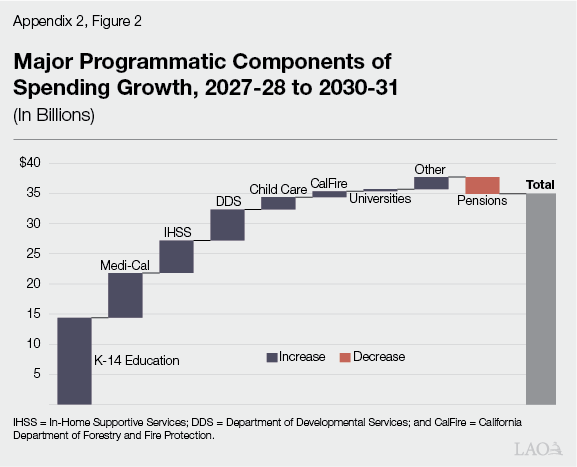
Out‑Year Spending Higher Than Budget Act Assumptions. Our estimates of out‑year spending are notably higher than those of the administration in June. Specifically, our spending estimates (excluding K‑14 education) are almost $7 billion and $10 billion higher in 2028‑29 and 2029‑30, respectively. These higher estimates are almost entirely driven by HHS programs (see Appendix 2 for the major cost drivers). Our estimates of spending on K‑14 education are similar to the administration’s June estimates in these years—with our figures about $1 billion lower and $500 million higher, respectively.
Overall Spending Growth Somewhat Slower Than Recent Estimates. While our out‑year spending estimates are higher than those of the administration, our estimate of the spending growth rate has declined. Under our forecast, average annual spending growth is 4.3 percent from 2027‑28 to 2030‑31. This growth rate is more than 1 percentage point lower than our out‑year estimates from our prior two Outlooks. In part, this decline reflects recent actions taken by the state to reduce spending, most notably in Medi‑Cal, including freezing enrollment for individuals with unsatisfactory immigration status and lowering the asset limit for seniors to qualify for the program.
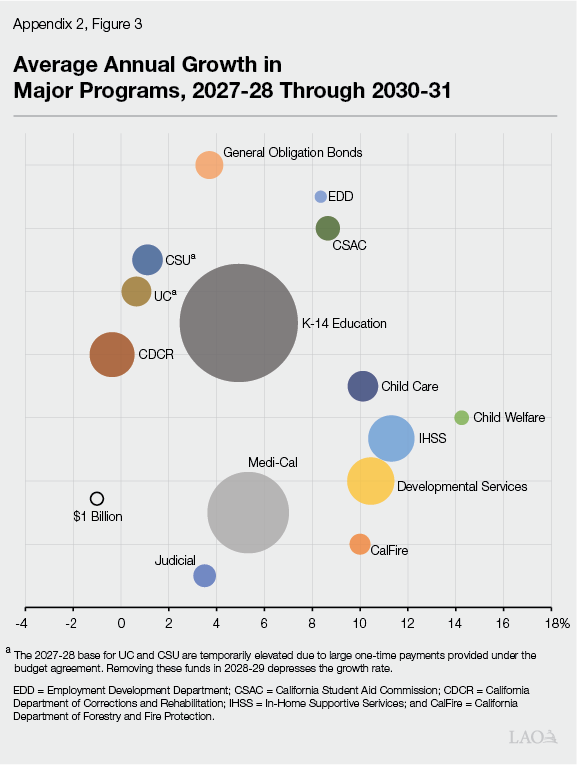
But Health and Human Services Programs Continue to Grow at Above Average Rates… As has been the case over at least the last several years, HHS program costs continue to grow relatively rapidly through 2030‑31. As a whole, we forecast growth in HHS programs of 6.6 percent on average, driven by Medi‑Cal (5.3 percent), developmental services (10.4 percent), In‑Home Supportive Services (IHSS) (11.3 percent), and child care (10.1 percent). The cost dynamics of major HHS programs include:
- Medi‑Cal. Recent budget solutions and H.R. 1 are expected to notably reduce Medi‑Cal enrollment, resulting in lower costs. We also assume the federal government will approve the Managed Care Organization tax adopted as part of the budget act, which offsets some General Fund costs. However, underlying growth in per‑enrollee costs and utilization more than offsets these factors, resulting in overall growth in the program. (See our report The 2026‑27 Budget: Medi‑Cal Analysis for more information about cost growth in Medi‑Cal.)
- Developmental Services. Costs in developmental services are driven by increasing caseload and utilization of services. Over the last ten years, General Fund spending on services for eligible individuals has increased by an average of 13.5 percent per year. (See our report The 2026‑27 Budget: Department of Developmental Services for more information about cost growth in developmental services.)
- In‑Home Supportive Services. IHSS costs primarily grow due to caseload, hours per case, and the state’s share of locally negotiated wages. Due to more recent, somewhat faster, caseload growth, we expect IHSS costs to be somewhat higher in the coming years. However, our assumed growth rate is lower than at historical peaks in the program when caseload growth exceeded 10 percent per year. (See our report The 2026‑27 Budget: In‑Home Supportive Services for more information about cost growth in IHSS.)
- Child Care. Cost growth in child care is due largely to the continued implementation of the Legislature’s slot expansion plan, a statutory cost‑of‑living adjustment (COLA), and assumptions about rate and caseload growth.
…As Do a Few Other Programs. A few other programs also are growing at above average rates:
- California Department of Forestry and Fire Protection (CalFire). We estimate CalFire costs grow about 10 percent per year. This is due to ending the Greenhouse Gas Reduction Fund cost shift, completing implementation of the 66‑hour duty week, and implementing salary increases as outlined by Chapter 581 of 2026 (AB 2129, Flora).
- Employment Development Department (EDD). We estimate EDD costs grow by 8.4 percent per year. This is driven by increasing interest costs on the state’s unemployment insurance loan from the federal government. (We assume the interest rate increases over the period—in line with recent trends in the 10‑year Treasury rate.)
- California Student Aid Commission (CSAC). We estimate CSAC costs grow by 8.7 percent per year. The largest driver is expected caseload growth.
Offsetting these increases are declines in costs for pensions, especially the teachers’ pension system. This is due to the projection that the state will successfully pay off its share of the unfunded liability based on current market conditions and the funding plan.
Schools and Community Colleges
Proposition 98 Funding Requirement Controlled by Formulas. Proposition 98 establishes a minimum annual funding requirement for schools and community colleges. The state calculates this requirement using formulas in the State Constitution that account for General Fund revenue and other inputs. The state recalculates the requirement as these inputs change. Each year, the adopted budget includes new estimates for the previous, current, and upcoming years. When the Proposition 98 requirement exceeds the initial estimate, the state makes one‑time payments to “settle up” for the difference.
Proposition 98 Requirement Up More Than $4 Billion Relative to June Forecast. Compared with the June 2026 budget forecast, our estimates of the Proposition 98 requirement are up $1.3 billion (1 percent) in 2025‑26, up $5.7 billion (4.4 percent) in 2026‑27, and down $2.7 billion (2.1 percent) in 2027‑28. Regarding the increases in 2025‑26 and 2026‑27, constitutional formulas will likely require the state to deposit a portion into a dedicated account known as the Proposition 98 Reserve. The remaining portion could support additional one‑time spending for schools and community colleges.
Large COLA Projected in 2027‑28. Regarding 2027‑28, our estimate of the Proposition 98 requirement—though below the state’s June estimate—is still $1.4 billion higher than the previously enacted budget level. In addition to these increases, more than $4 billion in ongoing Proposition 98 funds previously dedicated to one‑time school and community college spending will be freed up in 2027‑28. Under our outlook assumptions, these ongoing increases could cover most—roughly three‑quarters—of the statutory COLA for existing school and community college programs, which we estimate at 7.88 percent (well above the historical average of about 3 percent). Constitutional formulas also would likely require the state to withdraw several billion dollars from the Proposition 98 Reserve in 2027‑28, making additional one‑time funding available. Using one‑time funds to cover COLA, however, would make ongoing programs more vulnerable to future revenue declines.
Assume Settle Up Payment of $4 Billion. As we already discussed, we assume the state makes a $4 billion settle‑up payment associated with the 2025‑26 minimum guarantee. (The June 2026 budget revised the state’s estimate of the Proposition 98 requirement up in 2025‑26 but did not provide a $4 billion settle‑up payment associated with that increase.) Budget trailer legislation passed in June had formulas requiring funds be set aside for settle‑up under certain conditions. Those formulas do not trigger a payment under our revenue forecast. We assume new Proposition 2 requirements are dedicated to paying off the settle‑up obligation, although the Legislature has other options for fulfilling this requirement. If the Legislature does not address the settle‑up obligation by August 2027, current law requires the State Controller to allocate the remaining funding as a per‑student block grant to schools and community colleges on a schedule developed by the Director of the Department of Finance.
Conclusion
California’s budget is structurally overextended despite booming and near‑record revenues. The state is relying on evidently peaking market conditions just to maintain fragile budget balance. There is a clear and present risk of a market crash, which would carry dire budgetary consequences. The recently amended Proposition 2 will strengthen the state’s reserves over time but is too new for its benefits to have been fully realized.
As the Legislature begins the upcoming budget process, we encourage policymakers to keep in mind that the budget situation can change quickly. During past downturns, most notably the Great Recession, revenue estimates had to be revised downward repeatedly—within the same year—as conditions quickly deteriorated. The reality is that markets will change much faster than the budget process can respond. By explicitly factoring stock market risk into our forecast and presenting a market crash scenario, we aim to give the Legislature as much time as possible to plan, so that if a downturn arrives, the state is as prepared as possible. We also will continue to closely monitor collections and market trends with the aim of identifying a downturn, should one occur, as soon as possible.
In the spring, we plan to publish an updated outlook, which will provide our updated budget assessment based on additional months of economic and revenue data, up‑to‑date cost data, and the Governor’s budget proposals. Whereas this Fiscal Outlook aims to give the Legislature a starting place for thinking about the upcoming budget cycle, our spring outlook will aim to help the Legislature consider the budget’s structural position heading into the May Revision and adopting a budget package.
Appendix 1
Appendix 1, Figure 1
Fiscal Outlook Revenue Forecast
(In Billions)
|
2025‑26 |
2026‑27 |
2027‑28 |
2028‑29 |
2029‑30 |
2030‑31 |
|
|
Personal income tax |
$148.4 |
$158.5 |
$141.0 |
$149.8 |
$159.3 |
$169.4 |
|
Corporation tax |
45.0 |
45.8 |
46.8 |
49.0 |
50.0 |
49.3 |
|
Sales tax |
34.9 |
36.6 |
38.8 |
40.6 |
41.9 |
44.0 |
|
Total “Big Three” Revenue |
$228.4 |
$240.9 |
$226.6 |
$239.4 |
$251.1 |
$262.6 |
|
Other revenues |
$11.8 |
$11.0 |
$11.3 |
$10.6 |
$10.8 |
$10.8 |
|
Total Revenues |
$240.2 |
$251.9 |
$237.9 |
$250.0 |
$261.9 |
$273.4 |
Appendix 1, Figure 2
Stock Market Crash Revenue Scenario
(In Billions)
|
2025‑26 |
2026‑27 |
2027‑28 |
2028‑29 |
2029‑30 |
2030‑31 |
|
|
Personal income tax |
$148.4 |
$150.4 |
$112.3 |
$114.8 |
$127.4 |
$141.4 |
|
Corporation tax |
45.0 |
45.8 |
46.8 |
49.0 |
50.0 |
49.3 |
|
Sales tax |
34.9 |
36.6 |
38.8 |
40.6 |
41.9 |
44.0 |
|
Total “Big Three” Revenue |
$228.4 |
$232.8 |
$197.9 |
$204.4 |
$219.2 |
$234.6 |
|
Other revenues |
$11.8 |
$11.0 |
$11.3 |
$10.6 |
$10.8 |
$10.8 |
|
Total Revenues |
$240.2 |
$243.8 |
$209.2 |
$214.9 |
$230.0 |
$245.4 |
|
Note: The crash scenario is applied to personal income tax revenues. |
||||||
Appendix 2
Appendix 2, Figure 1
General Fund Spending by Agency Through 2030‑31
(In Billions)
|
Agency |
2025‑26 |
2026‑27 |
2027‑28 |
2028‑29 |
2029‑30 |
2030‑31 |
Average Annual Growtha |
|
Legislative, Executive |
$7.2 |
$4.3 |
$4.0 |
$3.4 |
$3.4 |
$3.4 |
‑5.3% |
|
Courts |
3.3 |
3.9 |
3.7 |
3.8 |
3.9 |
4.0 |
3.2 |
|
Business and Consumer Services |
— |
— |
— |
— |
— |
— |
— |
|
Housing and Homelessness |
2.4 |
1.4 |
0.2 |
0.2 |
0.2 |
0.2 |
— |
|
Transportation |
0.2 |
0.1 |
— |
— |
— |
— |
— |
|
Natural Resources |
4.9 |
3.4 |
3.9 |
4.2 |
4.9 |
4.9 |
7.8 |
|
Environmental Protection |
0.3 |
0.3 |
0.1 |
0.1 |
0.1 |
0.1 |
— |
|
Health and Human Services |
90.6 |
90.4 |
94.4 |
100.7 |
107.6 |
114.4 |
6.6 |
|
Corrections and Rehabilitation |
14.0 |
14.0 |
13.5 |
13.4 |
13.4 |
13.3 |
‑0.4 |
|
Education |
19.1 |
20.8 |
21.7 |
19.6 |
20.5 |
21.3 |
‑0.7 |
|
Labor and Workforce Development |
1.1 |
1.0 |
1.0 |
1.1 |
1.2 |
1.3 |
7.8 |
|
Government Operations |
3.1 |
5.0 |
2.1 |
2.9 |
2.9 |
3.6 |
20.2 |
|
Non‑Agency Departments |
1.6 |
1.4 |
1.8 |
1.2 |
1.2 |
1.2 |
‑11.8 |
|
Tax Relief/Local Government |
0.8 |
0.6 |
0.6 |
0.6 |
0.6 |
0.6 |
— |
|
Statewide Expenditures |
2.5 |
2.5 |
5.0 |
5.8 |
6.9 |
7.5 |
14.7 |
|
Capital Outlay |
0.7 |
0.5 |
0.3 |
0.4 |
0.2 |
0.1 |
‑38.1 |
|
Debt Service |
5.6 |
6.0 |
6.1 |
6.3 |
6.5 |
6.7 |
3.3 |
|
Non‑98 Spending Total |
$157.4 |
$155.5 |
$158.4 |
$163.7 |
$173.5 |
$182.6 |
4.9% |
|
Proposition 98b |
$89.0 |
$98.6 |
$92.7 |
$97.9 |
$102.6 |
$107.1 |
4.9% |
|
Settle Up |
— |
— |
$3.9 |
— |
— |
— |
— |
|
Total Forecasted Spending |
$246.4 |
$254.1 |
$255.1 |
$261.6 |
$276.1 |
$289.8 |
4.3% |
|
aFrom 2027‑28 to 2030‑31. bReflects General Fund component of the Proposition 98 minimum guarantee. |
|||||||